
Official Incore Sports
Frequently asked questions
Competition or hardstyle kettlebell — which one do I need?
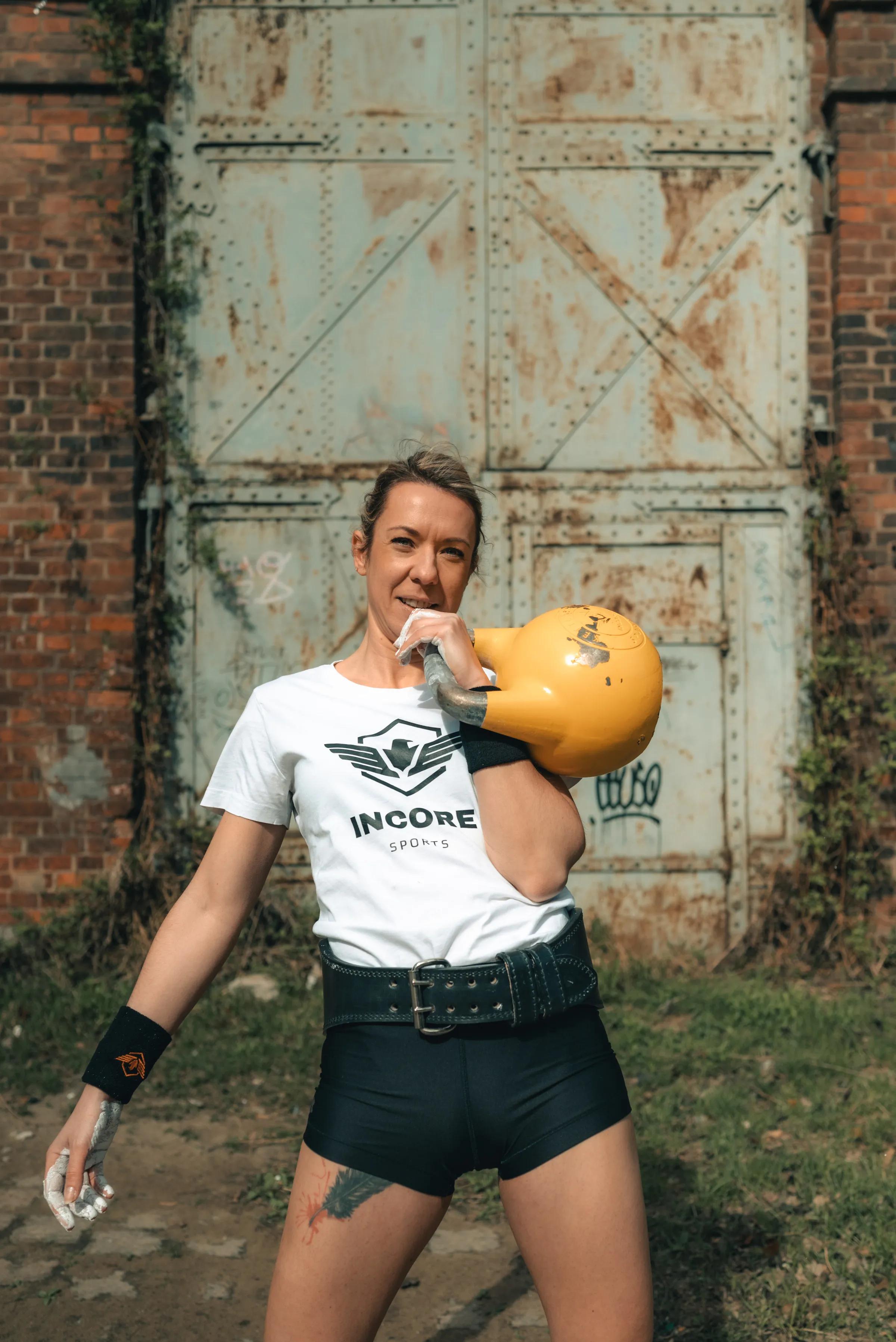
It comes down to what you train for. If you do kettlebell sport (girevoy) — snatch, jerk and long cycle for reps against the clock — choose a competition kettlebell: it is steel, keeps identical dimensions at every weight, and lets your technique stay repeatable as you move up. If you do hardstyle, CrossFit or general strength & conditioning — swings, get-ups, presses, flows — a cast-iron hardstyle bell is the better value and its more compact heavy sizes sit closer to your body. A useful shortcut: if the goal is a ranking or a timed set, go competition; if the goal is strength and conditioning, go hardstyle.
What kettlebell weight should I start with?
Pick a weight you can move with clean form, not the heaviest you can survive. For most beginners that means roughly 12–16 kg for men and 8–12 kg for women; complete beginners or those returning from injury can start at 8 kg (men) or 4–6 kg (women). If you already lift but have never trained kettlebells, the movement is new even if you are strong — start around 16–20 kg (men) or 8–12 kg (women) and earn the jump. Two-hand swings tolerate more load than overhead work, so if you only buy one bell, size it so a set of 15–20 swings stays technically clean but still challenges you.
Is 32 kg a good first kettlebell?
Almost never. Kettlebell training is a skill before it is a strength feat — the hinge, the rack, the overhead lockout, grip and breathing all have to be learned, and a 32 kg bell punishes the smallest error in that chain. Even strong lifters routinely start lighter because the movement pattern, not the muscles, is the limiter. If you want a single bell that grows with you instead of buying several, an adjustable 12–32 kg competition kettlebell is the smarter buy than jumping straight to a fixed 32 kg.
How many kettlebells do I need for a home gym?
One good bell already covers swings, cleans, presses, squats and get-ups — it is the most efficient single piece of equipment you can own. To keep progressing, two or three bells spaced roughly 4–8 kg apart cover most people: a lighter one for presses, snatches and technique, a heavier one for swings and squats, and a middle bell to bridge them. Buy a matched pair only once you are training double-bell work (double clean, double jerk, double front squat) — before that, a second identical bell mostly sits on the floor.
Should I buy one kettlebell or a matched pair?
Start with one. A single bell is the best teacher for the hinge, the rack and single-arm control, and it forces you to fix left–right imbalances one side at a time. A matched pair is an intermediate-to-advanced purchase for double kettlebell training — double clean, double jerk, double long cycle and double front squat — where both bells share the rack and the demand on the trunk roughly doubles. If you are not yet training doubles, your money is better spent on a second, different weight.
Are competition kettlebells colour-coded?
Yes — the colours follow the international girevoy standard so you can read the weight across a gym floor: 8 kg pink, 12 kg blue, 16 kg yellow, 20 kg purple, 24 kg green, 28 kg orange, 32 kg red. Incore Sports competition kettlebells use this standard. Because a hardstyle bell already changes size with weight, our cast-iron line instead carries a colour-coded stripe on the handle for the same at-a-glance identification.
What weight should I choose for a macebell or clubbell?
Forget the number and respect the lever. Because the mass sits far from your hands, the weight feels far heavier than the same figure on a kettlebell. For a macebell, start around 4–6 kg (men) and 3–4 kg (women); for a clubbell, whose mass sits closer to the hand, around 4–6 kg (men) and 2–4 kg (women). The macebell has the longest lever and is the most technically demanding of the three, so if you are unsure, go one step lighter and earn the leverage with clean 360s before loading up.
What are Incore Sports kettlebells made of, and how are they built?
Competition kettlebells are a single hollow casting — no welds, no internal filler — with a nominal 34 mm polished handle (actual measurements 33–35 mm by axis; cross-section not perfectly circular) whose widened corners reduce forearm pressure during high-rep sets; they are steel, except the 4 and 6 kg which are aluminium to preserve the shared shape at the light end. Weight tolerance is ±100 g. Hardstyle kettlebells are single cast iron, powder-coated black with a colour stripe, with a 33 mm handle on most sizes (40 mm at 28 kg, 38 mm at 32 kg). Macebells and clubbells are solid steel in matte black.
Are Incore Sports kettlebells suitable for competition?
Yes. The competition line is built to the international girevoy standard — uniform dimensions, standard colours, ±100 g tolerance — and both the competition and cast-iron lines are professional-grade training gear. Incore Sports equipment has been used at IUKL kettlebell World Championships and at the Polish Championships in 2023–2025, and by top international athletes. In other words, this is gear that has already been put on the platform, not just marketed for it.
What is a macebell good for?
The steel mace is a leverage tool. With the weight concentrated at the end of a long handle, movements like the 360 and 10-to-2 drive the shoulders through a big, controlled arc while the core resists rotation — building rotational strength, shoulder mobility and stability, body control and a grip that has to hold the lever throughout. It is popular with combat athletes and in functional training, and it trains ranges of motion that barbell work usually skips. It is more technically demanding than a kettlebell, so begin light.
What is a clubbell good for?
The clubbell is a shorter-lever cousin of the mace — its mass sits closer to your hand, so the leverage is challenging but easier to control. Swinging and circular movements (mills, swipes, shield casts) build wrist, forearm and shoulder resilience, rotational strength, coordination and grip, taking the joints through loaded rotation that keeps the shoulders healthy for heavy pressing. It sits between a kettlebell and a mace, which makes it a great mobility, prehab and accessory tool used single or in pairs.
Kettlebell vs dumbbell — what is the difference?
The offset handle is the whole point. On a kettlebell the mass hangs below and behind your grip, so it wants to swing and rotate — perfect for ballistic hinge patterns like swings, cleans and snatches, and it loads the rack and overhead positions differently than a dumbbell. A dumbbell keeps the load balanced in line with your hand, which suits presses, rows and curls. They are complementary tools; a kettlebell simply unlocks the ballistic, full-body work a dumbbell cannot do well.
Do the products have a warranty?
Yes — every Incore Sports product carries a 2-year warranty, covering kettlebells, macebells, clubbells and accessories. Because the bells are single castings with embossed (not painted-on) logos and weight markings, a bell can be repainted and used for years; chipped powder coat from hard use is cosmetic and does not affect function.
Which countries do you ship to?
We ship across Poland, the EU, the United Kingdom, Ireland, Norway and Switzerland, and our products have already reached more than 40 countries. Shipping to North and South America is in preparation and not yet available. Orders for Poland are handled by incoresports.pl; orders for Europe and international customers by incoresports.eu.
How do I care for my kettlebell, macebell or clubbell?
Keep it dry. Store the gear indoors, wipe off sweat after training and avoid prolonged contact with moisture — bare and cast steel will surface-rust if left damp or outdoors. For grip, a light pass with fine sandpaper on the handle helps chalk bite without over-roughening it. Powder coat may chip with heavy use; that is normal and purely cosmetic. A little care and these are lifetime tools.
When was Incore Sports founded, and what does it make?
Incore Sports was founded in Poland in 2023, out of a simple gap: there were no good competition kettlebells for people training kettlebell sport seriously. It started with kettlebells and grew into hardstyle bells, macebells, clubbells, belts, wristbands and accessories, with magnetic add-on weights and expanded apparel planned next. The brand is built by people who train, for people who train.
Where can I buy Incore Sports products?
This website is the brand's knowledge hub — it does not sell directly. Orders are handled by our official regional stores: incoresports.pl for Poland and incoresports.eu for Europe and international customers. Choosing your regional store means correct pricing, shipping and support for where you are.
Official Incore Sports
Choose your store
To buy, choose your regional store: