
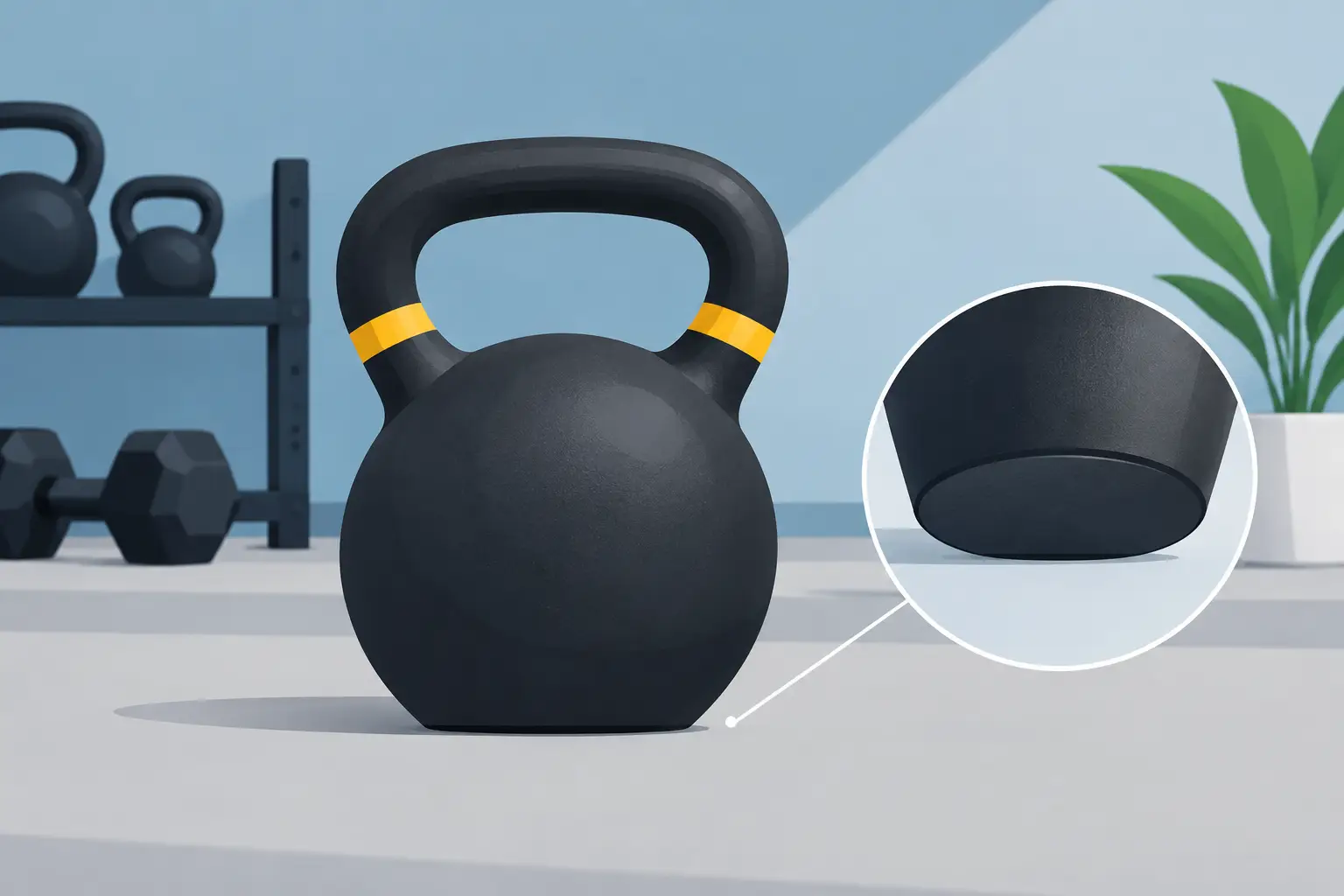
A kettlebell that will not stand upright creates problems before the workout even starts. It rolls in storage, shifts during floor work, and makes clean setup less controlled. So, why do kettlebells have flat bases? The short answer is stability. The better answer is that a flat base supports safer handling, more useful exercise options, consistent construction, and equipment that holds up under hard training.
A flat base is not a cosmetic detail. It is part of how the bell performs. Whether you train swings in a garage, coach group sessions, or build conditioning for sport, the base affects what happens when the kettlebell is on the ground.
A flat base keeps the kettlebell stable
The main purpose of a flat base is simple: it allows the kettlebell to sit upright without rolling. That matters in a crowded home gym, a commercial facility, or any training space where multiple bells are moving between sets.
A stable bell is easier to place down with control after swings, cleans, snatches, and carries. It also stays where you put it. That reduces the chance of a kettlebell rolling into a rack, wall, foot, or another athlete's working area.
The benefit is especially clear with heavier loads. A 24 kg or 32 kg bell that tips or rolls is more than inconvenient. It can damage flooring, interrupt a set, or create a real safety issue. A broad, level contact point gives the bell a predictable resting position.
Not every flat base is equal. A base that is too small relative to the bell can still feel unstable. One that is poorly finished may rock on the floor. Quality construction matters: the base should be level, the bell should not wobble, and the casting or shell should distribute weight evenly.
Why do kettlebells have flat bases for floor exercises?
Flat bases expand what you can do with a kettlebell beyond ballistic lifts. Many strength and mobility drills begin or end with the bell resting on the floor. A stable base makes those positions more reliable.
For example, a flat-bottom kettlebell works well for elevated push-ups, renegade rows, plank drags, and certain controlled get-up variations. In these movements, the bell becomes a fixed point of contact. You need it to stay planted while your body moves around it.
There is a trade-off. A kettlebell should not replace purpose-built push-up handles when wrist comfort or maximum stability is the priority. The handle can place the wrist in an awkward angle, and a high-volume athlete may be better served by separate handles. But for occasional strength circuits and general functional training, a flat-based bell gives you more options from one piece of equipment.
The base also helps with dead-stop training. In a dead-stop swing, clean, or snatch setup, the bell starts from a quiet position on the floor each rep. This can build better power production and reduce the temptation to use a loose rebound between repetitions. The bell needs to sit consistently so you can set your hinge, brace hard, and attack each rep with intent.
The base supports clean storage and faster training flow
Equipment that stores upright is easier to organize. Flat-based kettlebells line up cleanly on shelves, floors, and platforms. Weight markings stay more visible, handles are easier to reach, and the training area looks less like a pile of cannonballs.
That practical detail matters more as your collection grows. A single bell can sit almost anywhere. A full range of weights needs order. Coaches need athletes to identify the right load quickly. Home trainees need to know where equipment belongs after a session. Flat bases make that easier.
They also protect the bell from unnecessary wear. When a kettlebell rests upright, its base carries the contact with the floor. The body and handle are less likely to scrape against other equipment. This does not make a bell indestructible. Repeatedly dropping any kettlebell, especially on hard concrete, can damage the finish, chip the base, or harm the floor. Train with control. Earn your reps without abusing your equipment.
Flat bases and competition kettlebells
Competition kettlebells are designed around standardized dimensions. A lighter competition bell and a heavier one typically share the same overall body and handle size, while the internal construction changes to create the different weight. Their flat bases are part of that standardized design.
For athletes training long-cycle clean and jerk, snatch, or high-repetition conditioning, this consistency is valuable. The rack position, handle window, and starting height from the floor remain familiar as load changes. Your technique does not need to adapt to a completely different bell shape every time you move up in weight.
The base on a competition kettlebell is usually wide and deliberately stable. It suits repeated floor setups, organized storage, and technical work where consistent positioning matters. It also helps when bells are placed down between intervals in a class or competition-style session.
That does not mean a competition bell is automatically the best choice for every lifter. Its uniform size can feel large for a beginner using lighter weights. Some trainees also prefer the more traditional feel of a cast-iron hardstyle bell for swings, carries, and general strength work. The right tool depends on the training goal, your hand size, and the loads you expect to use.
Flat bases on hardstyle cast-iron kettlebells
Hardstyle kettlebells are usually cast iron, with a body and handle formed as one piece. Their shape often changes more noticeably as weight increases. A light bell may be compact, while a heavy bell has a much larger body and base.
The flat base still serves the same essential job: stable parking, controlled floor starts, and better storage. But the experience can differ from a competition bell. As the body grows, the bell may sit at a different height and have a different center of mass. That is normal. The tool reflects the load.
For strength-focused work, this is often an advantage rather than a flaw. Hardstyle kettlebells are built for durable, repeated use in swings, goblet squats, deadlifts, presses, carries, and get-ups. A solid flat base keeps the bell dependable between efforts.
When choosing a cast-iron bell, inspect the underside as carefully as the handle. Look for a flat, even surface and a finish that will not catch or scratch your floor unnecessarily. A rough, uneven base is a poor sign, even if the bell looks impressive from the front.
What a flat base does not do
A flat base improves stability when the kettlebell is at rest. It does not make every exercise safe, and it does not correct poor technique. A bell can stand perfectly still on the floor while the athlete hinges poorly, overgrips the handle, or chooses a load that is too heavy.
It also does not mean you should use the kettlebell as a stepping platform, drop it from overhead, or treat it like a fixed gym bench. The base is built to support the bell, not every improvised exercise seen online.
If the bell rocks, spins unexpectedly, or has a visibly uneven bottom, stop using it for supported drills such as push-ups or rows. On soft rubber flooring, even a good base may feel less stable than it does on concrete or wood. Surface matters. Test the setup before loading your body weight onto the handle.
Choosing a kettlebell with the right base
Start with your training purpose. If you want standardized dimensions for technical snatches, clean and jerks, and repeatable conditioning work, a competition kettlebell is the logical choice. If your focus is durable general strength, swings, squats, presses, and carries, a hardstyle cast-iron bell may fit better.
In either case, the base should be flat enough to prevent rocking and wide enough to keep the bell secure during normal storage and floor setup. Do not choose solely by color, coating, or price. Check the handle finish, weight accuracy, casting quality, and base stability together. These are working tools. Small design details show up in every session.
A kettlebell with a flat base gives you a stable starting point. Use it for clean setups, controlled training spaces, and purposeful strength work. Then put the focus where it belongs: your hinge, your breathing, your progression, and the reps you are willing to earn.