
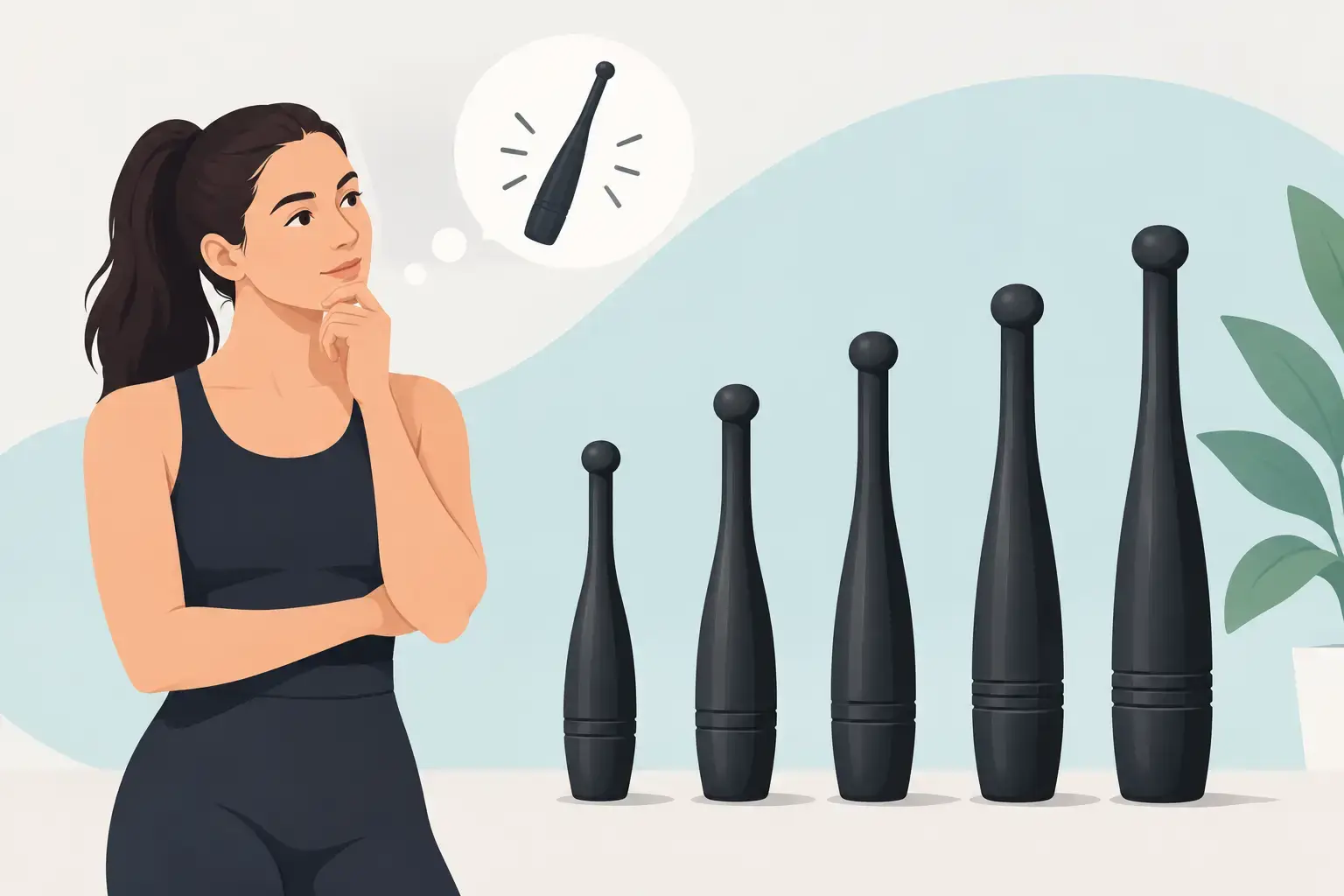
A clubbell can make a light load feel brutally honest. Its weight sits away from your hand, so leverage challenges the wrists, elbows, shoulders, trunk, and grip long before a dumbbell of the same number would. If you are asking which clubbell weight to buy, start with movement quality, not ego. The right club lets you control the arc, own the catch, and repeat clean reps without compensating through the lower back or shoulder.
Clubbell training builds mobility and strength at the same time, but only when the load matches your current skill. Start too heavy and your practice turns into survival. Start appropriately and you can accumulate precise reps, improve joint control, and earn the heavier club.
Which Clubbell Weight Matches Your Training?
There is no universal starting weight. Your best choice depends on whether you are new to offset-loaded tools, your shoulder history, your grip strength, and the movements you plan to train. A strong barbell lifter may still need a modest clubbell because mills and casts demand coordination through a long lever. Conversely, an experienced mace or club athlete may quickly outgrow an introductory load.
For most adults, these ranges are a practical place to begin:
- 4 kg / 8.8 lb: Best for new clubbell users, shoulder-mobility work, controlled circles, and learning single-arm mechanics.
- 6 kg / 13.2 lb: A strong starting option for trainees who already have solid pressing strength, grip control, and healthy shoulders.
- 8 kg / 17.6 lb: Suitable for experienced strength trainees who can demonstrate stable, pain-free clubbell patterns from the first session.
- 10-12 kg / 22-26.5 lb: Better for athletes with established clubbell experience or for two-hand strength work after technique is consistent.
- 15 kg / 33 lb and above: Advanced territory for powerful two-hand work, heavy presses, and trained single-arm practice. It is not the place to learn mills.
These are starting ranges, not status labels. A 4 kg clubbell used with control will build more than a 12 kg clubbell swung with a loose grip and unstable shoulder. The goal is progressive training, not proving that you can survive the first workout.
Why Clubbell Weight Feels Different
A clubbell is not loaded like a kettlebell or dumbbell. Most of its mass sits below the handle. That shifts the center of mass farther from the hand and increases torque at the wrist, elbow, and shoulder. During a mill, shield cast, or reverse swing, the club is constantly trying to pull your arm out of position.
This is exactly why clubbells are valuable. They teach your shoulders to create stability while moving through a large range of motion. Your forearms and grip work hard to control rotation. Your trunk has to resist twisting and extension. But the same leverage that makes the tool effective makes poor weight selection obvious.
Do not choose based on what you curl, bench press, or swing with a kettlebell. Those numbers tell part of the story, but they do not measure your ability to decelerate an offset load behind the body and guide it back into position. Clubbells expose that gap quickly.
Match the Load to the Movement
The clubbell weight you can use depends on the exercise. A load that is manageable for a two-hand pendulum may be excessive for a single-arm mill. Treat each pattern separately.
For circles, pendulums, and basic front holds, you can usually handle more weight because the movement is simpler and often uses both hands. For shield casts, mills, and single-arm presses, use less. These movements require clean timing and joint control at the most vulnerable positions of the arc.
A practical rule: buy for the most technical movement you intend to practice, not the strongest movement you can perform. If your goal is single-arm mills, select a weight that lets you mill with full control. You can always use that same club for carries, presses, and slower strength work.
Use a Technique Test Before You Progress
Your first sessions should be assessments. Do not chase fatigue. Start with a few controlled sets and judge the quality of every repetition.
A clubbell is likely too heavy if you need to bend or twist through the lower back to finish the arc, if the shoulder hikes toward the ear, or if you cannot slow the club down at the bottom of the movement. Pain, sharp pinching, numbness, and repeated loss of grip are all stop signals, not challenges to push through.
The correct starting load should allow you to maintain a tall posture, a firm but not death-tight grip, and a smooth path around the body. You should be able to pause in controlled positions without the wrist collapsing or the elbow flaring unpredictably. The final repetitions should demand focus, but they should still look like the first ones.
For a new pattern, begin with sets of 3 to 5 repetitions per side. Build toward 8 to 10 clean reps before increasing volume or weight. This gives the smaller stabilizing muscles and connective tissue time to adapt to rotational loading. Muscular strength can improve quickly. Tendons and joint tolerance need patient progression.
When to Move Up
Move to a heavier clubbell only when the current club no longer challenges you in the movement you are training. That means your technique remains sharp across multiple sessions, not just one good day.
Increase the load when you can control the start and finish of each repetition, keep your rib cage and pelvis stacked, and complete your planned volume without grip failure or shoulder irritation. If a heavier club forces you to shorten the range of motion or rush the catch, it is not yet your working weight.
Small jumps matter. Moving from 4 kg to 6 kg is a 50 percent increase, and the leverage can make that jump feel even larger. Spend time building repetitions, tempo, pauses, and unilateral control before assuming you need a heavier tool. Progress is not only measured in kilograms.
One Clubbell or a Pair?
If you are buying your first clubbell, one quality club is usually the smarter choice. Single-club work develops side-to-side awareness, rotational control, and grip strength. It also gives you room to learn the movements without doubling the coordination demand.
A pair makes sense later for synchronized pressing, front-loaded strength work, and bilateral conditioning. But two clubs do not replace the unique demands of unilateral training. Even advanced athletes benefit from keeping one club in the program for mills, casts, and offset carries.
If your budget allows only one purchase, choose the load that serves your technical training best. For many newcomers, that means 4 kg or 6 kg. For a well-trained athlete with strong shoulders and prior experience with macebells or clubs, 8 kg may be the right entry point. Honest assessment wins here.
Build Strength Without Sacrificing Mobility
Clubbell training works when strength and mobility support each other. Use controlled circles in the warm-up, practice technical patterns while fresh, then add carries, presses, and two-hand work for strength. Keep the volume realistic. Two or three clubbell sessions per week is enough to make progress while your shoulders adapt.
Do not treat a clubbell as a novelty or a shortcut. It is a precision tool for rotational power, resilient shoulders, grip strength, and athletic conditioning. Choose the load you can control today, train it consistently, and let clean repetitions earn the next weight.