
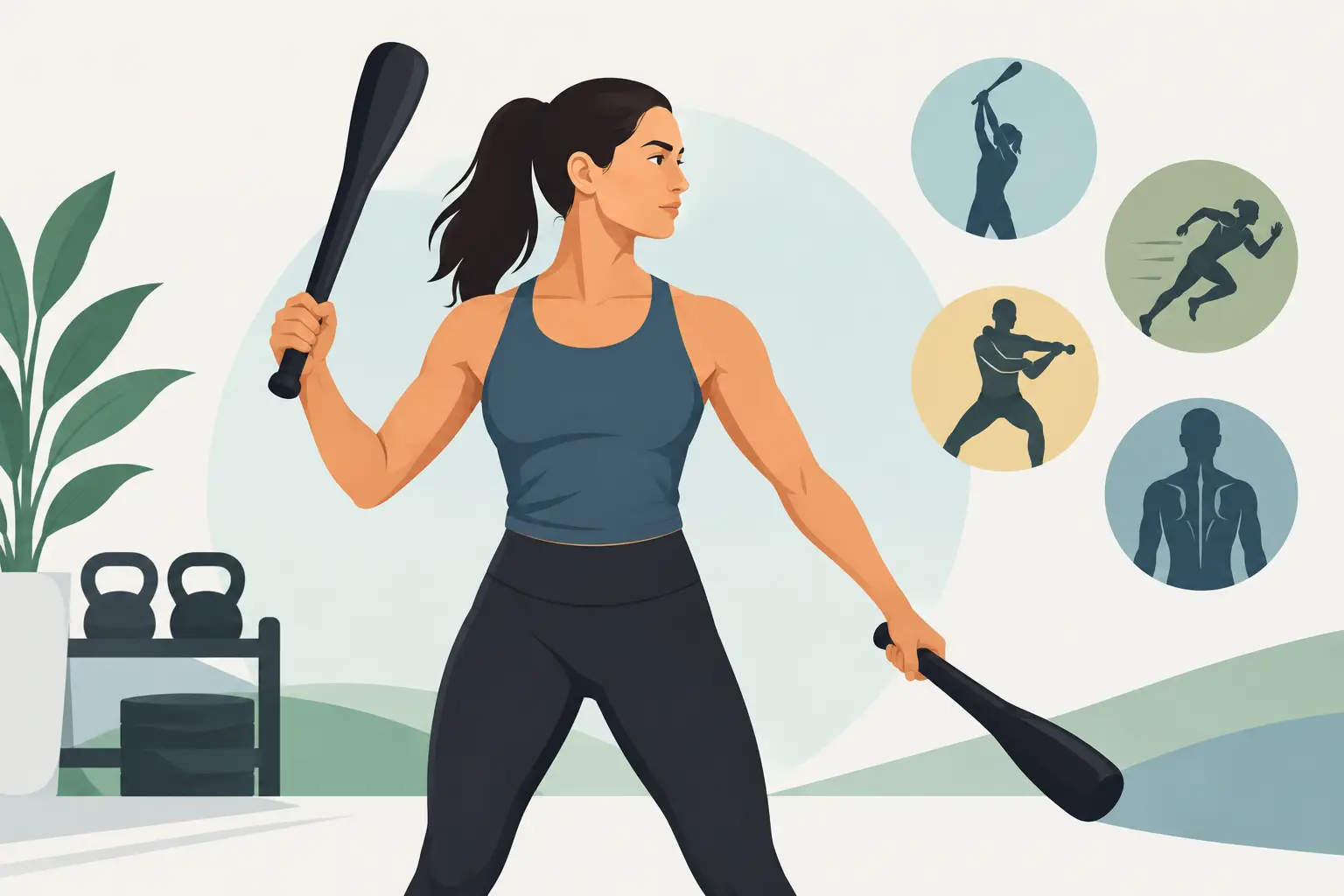
A barbell builds force in familiar lines. A clubbell asks you to control force farther from your hand, where leverage gets honest fast. Ask, “when should athletes use clubbells?” when shoulder durability, grip endurance, rotational control, and stronger movement through long ranges matter as much as adding weight to the bar.
Clubbells are not a replacement for squats, deadlifts, presses, or sport practice. They are a specialty tool. Used well, they fill gaps left by more symmetrical free weights: circular shoulder work, offset loading, deceleration, and hand-to-hand coordination. Used poorly, they become a flashy fatigue test. Earn your reps with controlled positions first.
When Should Athletes Use Clubbells?
Athletes should use clubbells when the training goal includes mobility under load, resilient shoulders and elbows, grip strength, or rotational strength that must transfer through the trunk. The long handle and concentrated mass at one end create leverage. That leverage makes even a modest clubbell demanding in ways a dumbbell of the same weight is not.
They fit particularly well during general preparation phases, off-season strength work, warm-ups, accessory sessions, and lower-intensity conditioning days. A field athlete can use them to build shoulder control between throwing or contact sessions. A combat athlete can use them to reinforce grip, posture, and rotation. Lifters and functional fitness athletes can use them to train the smaller stabilizers that help keep heavy pressing and pulling productive.
They can also be useful in-season, but the dose must shrink. The purpose then is maintenance, not chasing a new clubbell personal record. Two short sessions with clean, non-fatiguing work may support movement quality. Hard high-volume club circuits the day before a game, sparring session, or heavy overhead workout are usually a poor trade.
Use Clubbells When the Goal Is Mobility and Strength Together
Passive stretching has a place, but it does not teach you to own a position under force. Clubbells can. Controlled circles, mills, casts, and shield casts move the shoulder through changing angles while the trunk and grip stabilize the load.
This makes clubbells valuable for athletes who feel strong in basic lifts but restricted or unstable overhead. The answer is not always more range. Sometimes the missing quality is control at the edge of existing range. Start with a range you can manage without rib flare, elbow pain, or a loose grip. Increase range only as control improves.
The shoulder is not working alone. Clubbell patterns also ask the scapula to move and stabilize, the wrist to organize the handle, and the torso to resist unwanted rotation. That is why a light clubbell can be more useful than a heavy one when the goal is mobility and movement quality.
A Better Fit Than Heavy Pressing on Certain Days
After a heavy bench or overhead press session, more pressing volume is not always the answer. Low-load clubbell work can be a smarter accessory if it restores shoulder motion without adding another high-intensity demand. Keep the effort submaximal. The purpose is quality practice, not exhaustion.
Use Clubbells to Build Rotational Control
Sport rarely happens in a perfectly straight line. Throwing, striking, sprinting, changing direction, grappling, and swinging all involve rotation or resistance to rotation. Clubbells train this through their offset shape. As the club moves around the body, the athlete must create force, control momentum, and decelerate it without losing posture.
That last part matters. Many athletes can generate rotation. Fewer can stop it efficiently. Clubbell training gives coaches a practical way to train the brakes: grip, shoulder, trunk, hips, and stance working as a connected system.
For rotational power, do not confuse speed with chaos. Start with deliberate casts and mills before using faster, more ballistic patterns. If the pelvis spins uncontrollably, the ribs flare, or the shoulder shifts forward, the load or speed is too high. Power only counts when you can direct it.
Use Clubbells to Strengthen Grip, Wrists, and Elbows
A clubbell handle is not passive. It demands active crushing strength, wrist alignment, and constant adjustment as the center of mass moves. This can make clubbells a strong accessory for wrestlers, climbers, combat athletes, rowers, and athletes whose sport requires secure hands under fatigue.
The benefit is not limited to grip endurance. Gradual exposure to changing leverage may help develop tolerance in the forearms and wrists for athletes who already have a sound strength base. The key word is gradual. Tendons do not respond well to sudden volume spikes, especially when new rotational patterns are involved.
If you have active elbow, wrist, or shoulder pain, do not force clubbell training through it. Reduce the range, choose a simpler pattern, or get qualified assessment when needed. Clubbells are training tools, not a shortcut around an injury.
Where Clubbells Fit in a Weekly Program
Most athletes do not need daily heavy clubbell sessions. Two or three exposures per week is enough for many people, particularly when they are learning. Place them where they support the main work instead of competing with it.
Use light clubbell flows in a warm-up before upper-body lifting, throwing, or striking. Keep the sets short and technically clean. Use moderate accessory work after strength training when the goal is shoulder, grip, and trunk capacity. Place higher-rep conditioning work away from demanding overhead sessions or sport practices that require fresh shoulders.
A simple progression may look like this: begin with two sessions of basic two-handed patterns, then add controlled single-arm work, then increase total reps or time, and only later increase load or complexity. Change one variable at a time. More weight, more speed, more range, and more volume all at once is how technique breaks down.
Choose the Pattern Before the Load
The right clubbell weight depends on the exercise, your training history, and whether one or two hands are on the handle. There is no universal starting number that works for every athlete. A load that is appropriate for a two-handed shield cast may be far too heavy for a single-arm mill.
Start lighter than your ego prefers. The clubbell’s leverage exposes errors quickly. You should be able to maintain a stable wrist, controlled shoulder position, quiet ribs, and a secure grip through every rep. If you need to yank the club into position or catch it with a bent, collapsing wrist, step back.
For beginners, two-handed pendulums, front swings, and shield casts are usually better entry points than complex mills. Experienced strength athletes should still respect this progression. A strong deadlift does not automatically prepare the wrist and shoulder for loaded circular movement.
When Clubbells Are Not the Best Tool
Clubbells are not the first choice when the main need is maximal lower-body strength, heavy bilateral pressing, or highly specific sport skill practice. Barbells, kettlebells, dumbbells, machines, and the sport itself may be more efficient for those goals.
They are also not ideal for introducing fatigue when an athlete has poor overhead control or cannot maintain basic shoulder motion without compensation. Build fundamental strength and movement first. Then use clubbells to expand capacity.
Avoid treating every clubbell session as a nonstop flow. Flow training has value, but it can hide technical errors because momentum keeps the tool moving. Paused reps, controlled transitions, and lower-rep sets teach more when you are still learning.
A Practical Starting Dose
Begin with two weekly sessions of 10 to 15 minutes after a thorough warm-up or at the end of a strength session. Choose two or three basic patterns and perform low-to-moderate rep sets with full control. Rest enough to keep your grip and shoulder position sharp.
For example, an athlete might use two-handed pendulums, shield casts, and controlled front swings for several sets of five to eight repetitions. The exact exercise selection matters less than repeatable technique. Stop a set when the clubbell starts pulling you out of position.
Incore Sports clubbells are built for this kind of repeated, purposeful work: mobility and strength trained together, not treated as separate qualities. Keep the standard simple. If every rep looks controlled, add work slowly. If control fades, earn the right to progress before adding more load.