
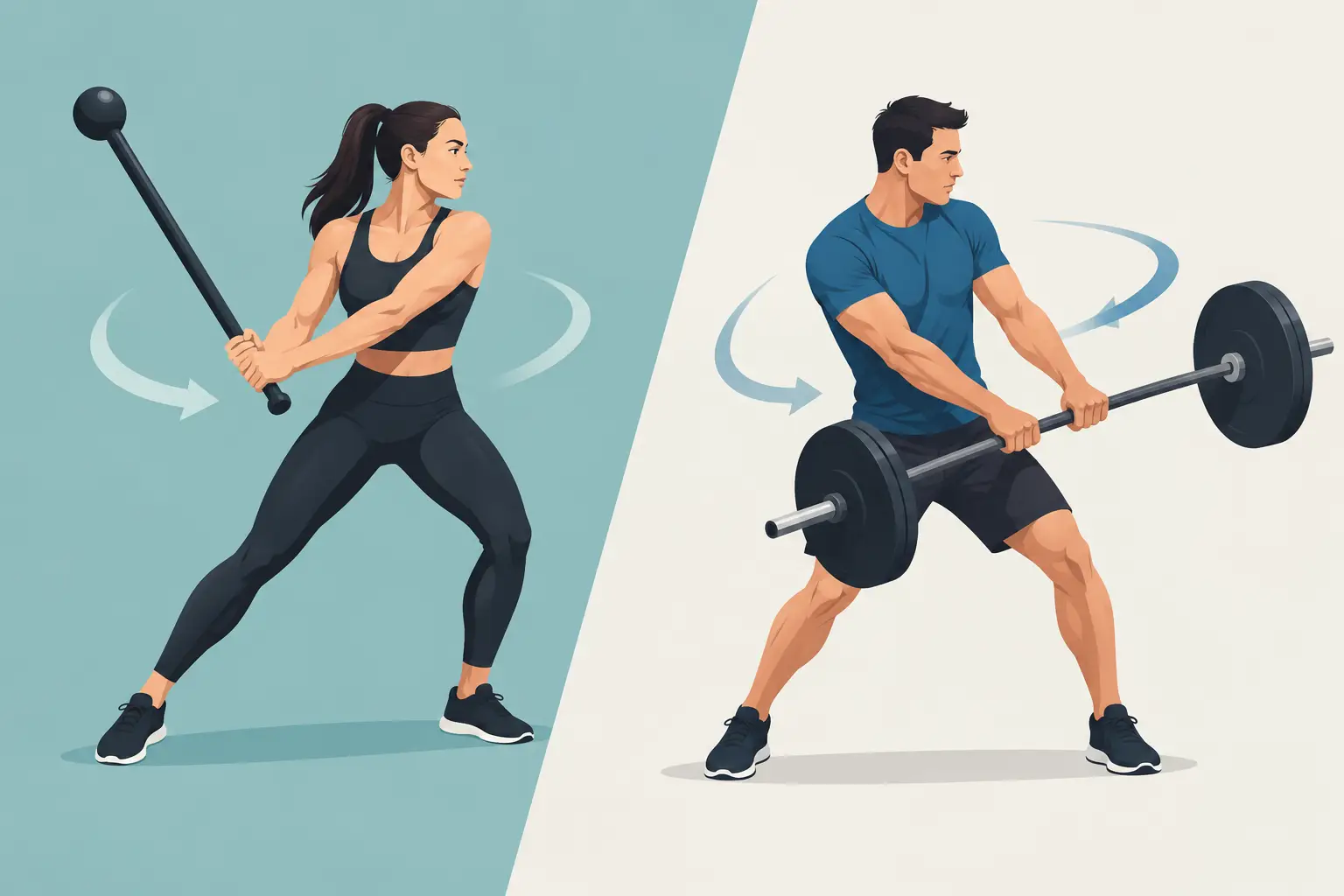
A barbell can make rotation look strong while quietly asking the hips, spine, and shoulders to manage a large amount of force. A macebell makes that force impossible to ignore. In macebell versus barbell rotational training, the better tool is not decided by tradition or load alone. It is decided by the pattern you need, the control you own, and the sport or task you are preparing for.
Rotational strength is not simply twisting under resistance. It is the ability to create force through the ground, transfer it through the hips and trunk, and either express or resist rotation at the right moment. Throwing, striking, sprinting, grappling, changing direction, and carrying awkward loads all demand some version of this skill.
The barbell and macebell develop different parts of that equation. Train both with purpose. Do not force one tool to do the other’s job.
The Main Difference Is Where the Load Sits
A barbell distributes mass on both sides of your hands. Even when one end is used for landmine work, the implement remains relatively predictable. The load moves on a stable line, and progression is easy to measure in plates, reps, sets, and bar speed.
A macebell puts most of the mass far from the hands. That long lever changes the demand immediately. A light mace can create a serious challenge because the head pulls the shoulders, wrists, trunk, and grip away from their preferred positions. You do not just move the macebell. You guide it, decelerate it, and bring it back under control.
This is why a 15-pound macebell can feel far more demanding than its number suggests. The training effect comes from leverage, not just total mass. The longer the lever, the more discipline the movement requires.
Macebell Versus Barbell Rotational Training: What Each Builds
Barbell rotational work is usually strongest when the goal is high-force output. Landmine rotations, split-stance presses, rotational rows, and pivoting presses allow athletes to load the legs and hips while training force transfer through the torso. The bar gives clear feedback. If your stance collapses, your timing is late, or your trunk cannot brace, the rep becomes inefficient fast.
The barbell also makes progressive overload simple. Add a small plate. Build volume. Track output across a training block. For athletes with a solid strength base, this makes it valuable for turning general strength into more specific rotational force.
Macebell work has a different emphasis. It trains rotational control, shoulder mobility under tension, grip endurance, and the ability to decelerate a moving offset load. Patterns such as 360s, 10-to-2s, inside circles, outside circles, and shield casts ask the upper body to stay organized while the mace head travels around it.
That does not mean macebell training is only mobility work. Done with sound mechanics, it can build serious strength through the shoulders, upper back, forearms, and trunk. But it is strength expressed through control and positioning. The reward is a body that can manage rotation rather than simply produce it.
Why the Spine Should Not Be the Main Mover
The most common error in rotational training is trying to create the movement from the low back. The lumbar spine can rotate, but it is not built to be the primary engine for repeated loaded twisting. The hips and thoracic spine should contribute most of the visible rotation. The trunk then transfers force while resisting unwanted motion.
With a barbell, this means setting the feet, loading the hip, and letting the pelvis and rib cage turn with control. Do not pin your feet and aggressively wrench the torso around. In a landmine rotation, the pivot is not an optional detail. It is part of the movement.
With a macebell, the same rule applies, but the consequences are more obvious. If you lose rib position during a 360 or compensate by cranking the lower back, the mace head will pull you into a poor path. Keep the ribs stacked over the pelvis, maintain a tall posture, and allow the shoulders to move without shrugging toward the ears.
Rotational power is built on a stable platform. First own the position. Then add speed or load.
When the Barbell Is the Better Choice
Choose barbell or landmine-based rotational training when your priority is measurable loading and power development. It is especially useful for field athletes, combat athletes, and experienced lifters who already have competent squatting, hinging, pressing, and bracing mechanics.
A landmine setup is often more practical than a free barbell for rotational patterns. One end stays anchored, the arc is predictable, and the athlete can learn to drive from the floor without managing a fully free bar. Half-kneeling landmine presses can train anti-rotation. Split-stance rotational presses can build coordination between the hips, trunk, and upper body. Standing landmine rotations can develop force transfer when the pivot is clean.
Use the barbell when you want to load a specific pattern without turning every set into a grip or shoulder-stability test. This matters in strength phases. If the goal is to build more force, choose the tool that lets you apply more force safely.
When the Macebell Is the Better Choice
Choose the macebell when your training needs more movement quality, overhead control, rotational endurance, and shoulder resilience. It is particularly useful for lifters who spend most of their week on straight-line barbell work, athletes who need durable shoulders, and anyone whose rotational training has become too stiff and predictable.
The macebell is also effective for teaching respect for tempo. You cannot rush a 360 just because you want a higher rep count. The descent behind the head must be guided. The catch must be timed. The return must come from a connected pull through the lats, upper back, grip, and trunk.
Start lighter than your ego prefers. A 10-pound macebell is enough for many beginners to learn the 360 and 10-to-2 with quality. Strong barbell lifters are not exempt. A heavy deadlift does not automatically prepare the wrists, shoulders, and timing for a long lever moving behind the head.
Incore Sports steel macebells are built for repeated rotational work, but durable equipment does not replace patient progression. Earn the pattern before increasing the load.
Program Both Without Creating Junk Volume
You do not need an entire session of rotation to benefit from it. The best approach is often to place the right rotational tool beside your primary strength work.
For a power-focused athlete, use landmine rotations or rotational presses early in the session after the warm-up, when coordination is sharp. Keep the reps low to moderate, usually four to eight controlled reps per side. Use enough load to demand intent, but not so much that the hips stop moving or the arms take over.
Use macebell drills as skill-strength work two or three times per week. Practice sets of three to six smooth repetitions per side for technical patterns such as 360s and 10-to-2s. For circles, mills, and simpler flow sequences, use short timed sets only after the basic positions are reliable. Fatigue can teach bad paths quickly.
A practical week might include heavy lower-body training with landmine rotations on one day, upper-body strength followed by macebell 360 practice on another, and a lighter conditioning session with clubbell or macebell flow later in the week. The tools complement each other when the total shoulder and trunk workload stays realistic.
Progression Is Not Just More Weight
With a barbell, progression can come from more load, more range, cleaner speed, a more demanding stance, or better timing between the lower and upper body. A heavier plate is useful, but it is not the only marker of improvement.
With a macebell, earn progression through cleaner hand transitions, a quieter torso, consistent arc, better left-to-right symmetry, and greater control at the farthest point of the lever. Add repetitions before adding much weight. Then add load in small jumps. A macebell that is too heavy turns rotational training into survival training.
Watch for warning signs with either tool: low-back discomfort during the turn, pinching at the front of the shoulder, elbows flaring without control, or feet losing contact with the floor. Reduce the load, shorten the range, or return to a simpler drill. Pain is not a technical cue.
The barbell teaches you to apply force. The macebell teaches you to own force once it is moving. Build both qualities patiently, and your rotation becomes more than a gym exercise. It becomes usable strength when the rep, the round, or the game demands it.