
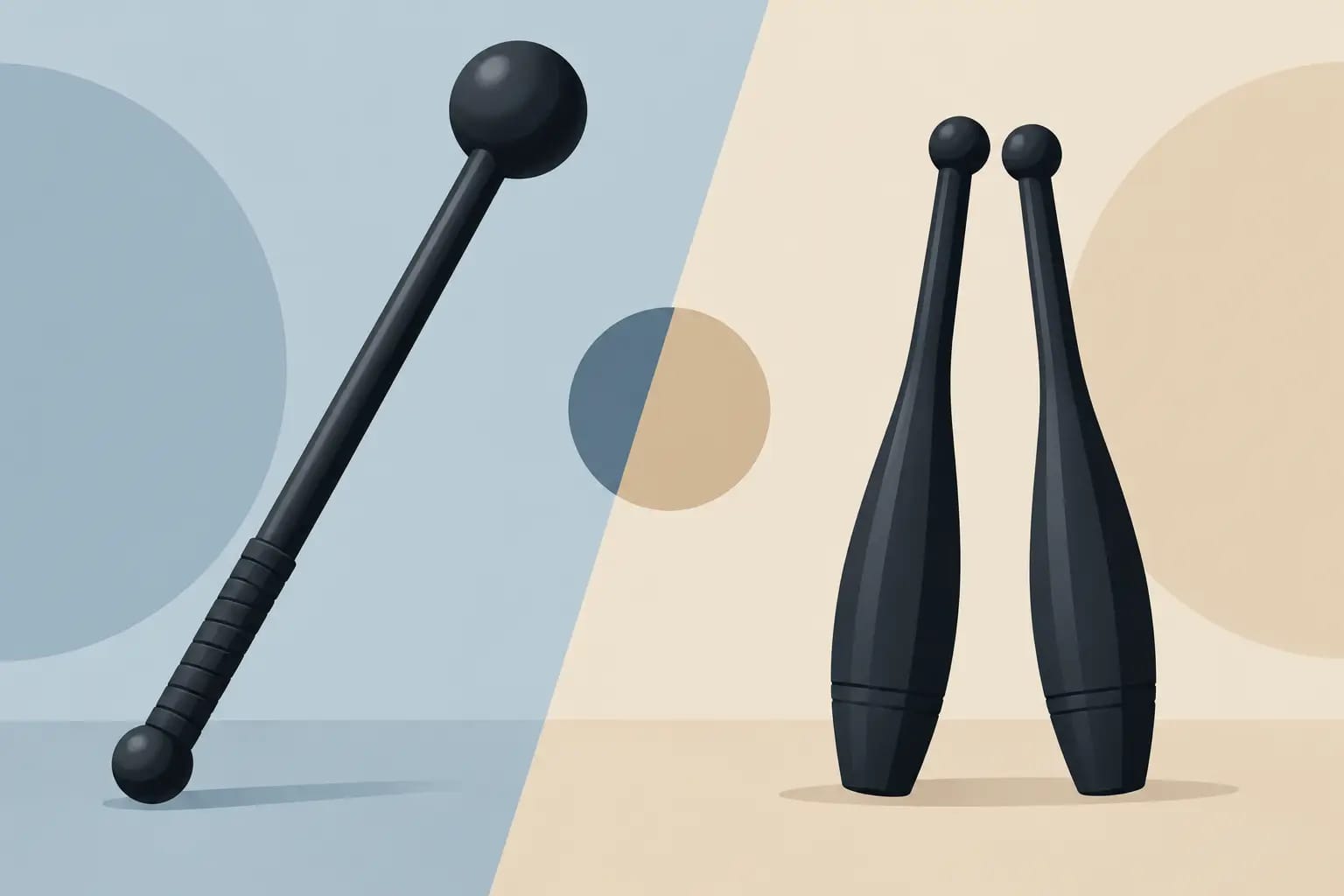
A 10-pound steel mace can humble a strong lifter. A 10-pound clubbell can expose shoulder control that barbells never ask for. In the mace versus clubbells decision, the number stamped on the tool matters far less than where that weight sits, how long the lever is, and what you expect your body to do with it.
Both tools build usable strength. Both demand grip, shoulder stability, trunk control, and clean movement. But they do not create the same training problem. Choose by objective, not by novelty.
Mace Versus Clubbells: The Core Difference
A steel macebell places most of its mass at one end of a long shaft. That long lever magnifies the load during swings, casts, and circular patterns. The further the mace head travels from your hands, the more torque your shoulders, grip, and trunk must manage. This makes the mace a serious tool for rotational strength and controlled movement under leverage.
A steel clubbell is typically shorter and more compact. Its weighted end still creates an offset load, but the reduced length changes the demand. Club work usually allows more freedom through the wrist, elbow, and shoulder while keeping the arc tighter. It is especially effective for building mobility and strength together, one controlled repetition at a time.
Neither is simply a lighter version of the other. A mace is not a club with a longer handle, and a club is not a beginner mace. Their geometry changes the training stimulus.
Choose a Mace for Rotational Power and Long-Lever Control
The mace earns its place when you want to train force through a long arc. The classic 360 and 10-to-2 are not tricks. Performed well, they teach the shoulders to move while the ribs, pelvis, and grip stay organized. That is valuable for athletes who rotate, strike, throw, grapple, carry, or need resilient shoulders under changing leverage.
Mace training also makes weak links obvious. If the hands cannot control the shaft, the head drifts. If the trunk loses position, the swing turns into a loose backbend. If the shoulders lack mobility or timing, the movement becomes forced. This feedback is useful, provided the load is light enough to learn from it.
Use a mace when your training goal is primarily rotational power, coordinated shoulder mechanics, and strength through large circular patterns. It also works well as a focused finisher after pressing, pulling, or kettlebell work, as long as fatigue does not turn technique into a gamble.
The trade-off is skill. A long lever punishes rushed progression. Heavy mace work has a place, but only after you can control the path, shift the hands smoothly, and keep the neck relaxed through repeated sets.
Good Mace Training Priorities
Start with two-handed patterns. The offset pendulum, front pendulum, 360 progression, and 10-to-2 progression teach the basic relationship between the hands, shaft, and mace head. Keep the arc deliberate. A clean repetition should feel connected through the feet, hips, trunk, shoulders, and hands.
Single-arm mace work comes later. It increases the anti-rotation demand dramatically and reveals left-to-right differences fast. Earn that progression with consistent two-handed control first.
Choose Clubbells for Mobility, Grip, and Strength
Clubbells are often the better choice when you want more training variety in a smaller space and a more direct path into unilateral work. Their compact shape supports mills, shield casts, swipes, presses, carries, and controlled strength patterns that challenge the hands and shoulders from angles dumbbells rarely provide.
The clubbell’s shorter lever does not make it easy. It simply concentrates the work differently. Your grip must steer the offset mass. Your wrist must remain active without collapsing. Your shoulder must produce and resist rotation while staying centered. These demands make clubbells useful for lifters who want stronger hands, better shoulder movement, and durable upper-body control.
Clubbells also fit well beside traditional strength work. A lifter who spends most sessions under a barbell can use clubs for warm-up flow, accessory pressing, carries, and low-volume movement practice. The goal is not to replace heavy basics. It is to build capacities that help you train those basics longer and with better control.
Good Clubbell Training Priorities
Begin with simple casts, shield casts, pendulums, and carries before chasing fast mills. These movements teach you to control the bell as it changes direction. Keep the elbow and wrist aligned with the intended path instead of gripping so hard that the entire arm becomes rigid.
Once that control is reliable, use clubbells for unilateral presses, mills, and combinations. Work both sides evenly, but pay attention to the weaker side. Do not let your dominant hand dictate the loading for both arms.
Weight Selection: Start Lighter Than Your Ego Wants
Offset tools are deceptive. A load that seems light on the floor can become demanding the moment it moves beyond the body. This is why a person who presses heavy dumbbells may still need a modest mace or clubbell for technical practice.
For many adults learning two-handed mace patterns, a 7- to 10-pound mace is a sensible starting range. Larger, stronger, or more experienced trainees may begin with 10 to 15 pounds, but only if they can maintain clean positions from the first session. Starting with a 20-pound mace because you can deadlift heavy is a poor test of strength and an expensive way to learn caution.
For clubbells, many new users do well with 5 to 10 pounds for technique work, particularly for mills and casting patterns. A 10- to 15-pound club may suit stronger trainees using basic casts, carries, and presses, but it can still be too much for circular skills. The right starting load depends on the exercise, your shoulder history, and your ability to control deceleration.
Use a simple rule: if you cannot stop the tool precisely, reverse it smoothly, and repeat the movement without changing posture, it is too heavy for that drill. Reduce the load, reduce the range of motion, or return to a simpler pattern.
Handle, Construction, and Training Space Matter
Steel construction gives both macebells and clubbells the durability needed for repeated training. It also creates a consistent, solid feel. That matters when the tool moves around your body at speed. You want predictable balance, a secure handle, and a finish that supports grip without feeling abrasive.
Handle length affects hand transitions on a mace. A longer usable shaft gives you room to adjust leverage, move the hands during 360 variations, and progress toward more demanding patterns. On a clubbell, handle comfort and diameter influence how well you can control rotation, particularly during longer sets and single-arm work.
Training space deserves equal attention. A mace needs clearance behind and around the body. Ceiling height matters for overhead work. Clubbells need less room, but circular movements can still meet a wall, rack, or training partner if you are careless. Clear the area before the set. Discipline starts before the first rep.
How to Use Both Without Diluting Your Program
You do not need to choose one tool forever. Mace and clubbell training work well together when each has a job. Use the mace for two or three focused sessions per week built around long-lever skill and rotational strength. Use clubbells for shorter, more frequent doses of mobility, grip work, carries, and unilateral control.
Keep the main work main. If your priority is maximal barbell strength, treat steel tools as support work rather than exhausting circuits before heavy squats or presses. If your priority is athletic conditioning and movement capacity, they can take a larger role, provided progression remains measurable.
A productive session may include five minutes of clubbell casts and carries before strength work, then a few technically sharp sets of mace 360s on a separate day. Stop while the repetitions are still crisp. Volume only counts when positions hold.
The Right Tool Is the One You Can Progress
Choose a mace if long-lever rotation, powerful arcs, and coordinated full-body tension are the priority. Choose clubbells if you want compact unilateral training that develops mobility, grip, and shoulder strength through controlled movement. If both goals matter, build skill with both, but do not rush the load.
The tool is only the beginning. Clean technique, patient progression, and repeated practice turn steel into training. Earn your reps.