
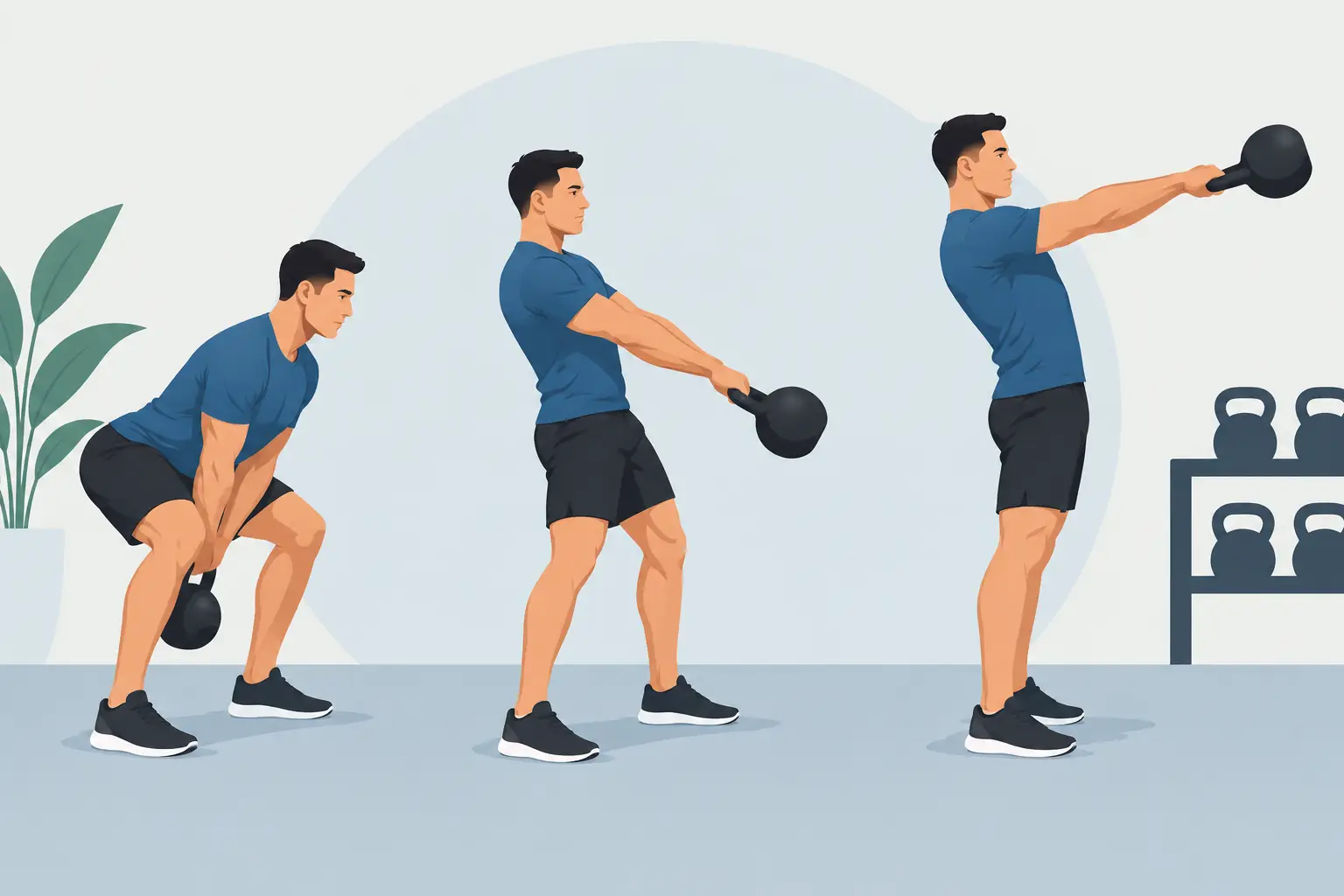
A powerful swing does not come from lifting the kettlebell with your arms. It comes from a sharp hip extension, a stable torso, and a bell that moves because you created force from the floor. That is the standard for kettlebell swing technique. Earn the position first. Then earn the speed.
The swing looks simple, which is why lifters often rush it. A few loose repetitions can turn a posterior-chain power drill into a low-back endurance test or a shoulder-heavy front raise. The fix is not more effort. It is better mechanics, an appropriate load, and enough discipline to stop a set when your positions fade.
What the Swing Is Designed to Train
The kettlebell swing is a ballistic hip hinge. Your glutes and hamstrings load as the bell travels back, then drive the bell forward as the hips snap into extension. Your trunk resists unwanted motion. Your lats keep the bell connected to your body. Your grip controls the handle without trying to overpower it.
A good swing builds hip power, conditioning, grip strength, and repeatable bracing under fatigue. It can fit strength sessions, athletic conditioning, and general physical preparation. But it is not the best first exercise for everyone. If you cannot hinge without rounding your lower back, or if you cannot hold a solid plank, build those patterns before adding ballistic speed.
The basic two-hand swing is the right place to begin. One-hand swings, hand-to-hand transfers, and higher-volume intervals demand more grip, anti-rotation control, and timing. They are progressions, not shortcuts.
Kettlebell Swing Technique Starts Before the First Rep
Set the bell on the floor about one foot in front of you. Stand with your feet roughly shoulder-width apart, though a slightly wider stance may suit your hip structure. Turn your toes out only as much as needed to let your knees track naturally.
Reach your hips back to hinge toward the bell. Your shins should stay close to vertical. Keep a long, neutral spine, with your ribs stacked over your pelvis. Then grip the handle with both hands, pull your shoulders away from your ears, and engage your lats as if you are trying to squeeze your upper arms against your ribs.
Before the bell leaves the ground, create tension. Press your feet into the floor. Brace your midsection. Keep your neck neutral and your eyes focused a few feet ahead, not cranked toward the wall in front of you.
The first movement is a hike pass, not a lift. Tip the bell toward you and pull it back between your thighs. The motion resembles snapping a football to a receiver behind you. Your forearms should brush the upper inner thighs. If the bell hangs low under your knees, you have likely squatted it backward instead of hinging.
The Hinge Is Not a Squat
In a squat, the knees travel forward and the torso stays relatively upright. In a swing, the hips travel back and the torso inclines forward while remaining braced. Your knees bend, but they do not lead the movement.
This distinction matters because the bell needs room to travel back. When the knees push forward too early, the bell drops low, your hips lose leverage, and your lower back often takes over. Think: hips back, bell back, then hips through.
Drive, Float, and Lock Out
From the loaded backswing, push the floor away and drive your hips forward hard. The power comes from your glutes. Your knees straighten as a result of hip extension, not because you are jumping or aggressively snapping the knees first.
At the top, stand tall. Your ankles, knees, hips, ribs, and shoulders should form a stable vertical line. Squeeze your glutes, brace your abs, and keep your shoulders packed. The bell should float to about chest height in a conventional hardstyle swing. Your arms stay long and relaxed enough to act as straps.
Do not lean backward to make the bell rise. Do not pull it upward with your shoulders. If you finish with your ribs flared, chin lifted, or low back arched, you have missed the lockout. A powerful rep feels crisp, not dramatic.
Then let the bell fall. Do not force it down. As gravity brings it back, guide the handle toward your hips, reconnect your lats, and fold into the next hinge at the last possible moment. The backswing should be loaded, compact, and controlled. Each repetition has a clear rhythm: hike, drive, float, hinge.
Breathe With the Rep
Breathing should support your brace, not interrupt it. Many lifters do well with a short, forceful exhale at lockout, sometimes called a power breath. Inhale as the bell returns into the backswing, then brace before the next hip drive.
The exact breathing pattern can vary with load and rep range. Heavier swings usually need a firmer brace and more deliberate breathing. For conditioning intervals, keep the breath rhythmic without letting your trunk go loose. If you cannot control your breathing, the set is probably too long, too heavy, or both.
Fix the Errors That Waste Power
Most swing problems are visible before they are felt. Film a set from the side when possible. Look for consistent positions rather than chasing a perfect-looking single rep.
You are lifting with your arms. If your shoulders and biceps burn before your glutes and hamstrings work, stop pulling. Drive the hips and let the bell float. A lighter bell can help you learn the timing, but an excessively light bell may also encourage you to muscle it around. Choose a load that gives clear feedback without pulling you out of position.
The bell drops too low. A deep, loose backswing usually signals a squat pattern or a late hinge. Keep the bell high between the thighs. Hinge earlier as the bell returns, while maintaining tension through the lats and trunk.
Your lower back rounds or overextends. Rounding at the bottom means you are reaching farther than your hamstrings can control. Overextension at the top means you are finishing through the lumbar spine instead of the glutes. Reduce range, reset your brace, and own a clean deadlift hinge before chasing more repetitions.
Your feet leave the floor or your weight shifts forward. The swing is forceful, but it is not a jump. Keep pressure through the full foot, with a strong connection through the heel and midfoot. If you are tipping forward, the bell may be too far from your body or you may be pulling with the arms.
Every rep looks different. Fatigue reveals weak positions. End the set when the hinge becomes a squat, the lockout softens, or the bell starts drifting away from you. Quality sets build skill. Sloppy sets rehearse mistakes.
Choose a Bell That Lets You Learn
Load selection depends on training history, body size, hinge skill, and the equipment available. There is no universal starting weight. A bell that is too light may not provide enough feedback for a true hinge. A bell that is too heavy can force a rounded back, a partial lockout, or an arm-driven swing.
For many new lifters, a moderate bell is more useful than the smallest option in the rack, but technique decides the load. Start with deadlifts, then controlled hike passes, then short swing sets. If you cannot pause at the top in a stable lockout, the load or volume is ahead of your current control.
Hardstyle cast-iron kettlebells suit traditional power-focused swings well. Their durable construction and familiar shape work for home training, gym floors, and repeated ballistic sessions. Competition kettlebells can also be used effectively, especially if you value the same external dimensions across different weights. Consistent bell size can make progression more predictable as your strength improves.
Do not begin with a 32 kg bell because it looks serious. Serious training is choosing the load you can move with intent, control, and repeatable mechanics.
Build Volume Without Losing the Hinge
Swings reward submaximal practice. Start with short, clean sets such as 5 to 10 repetitions, resting long enough to repeat the same crisp pattern. Five sets of 10 strong reps are more productive than one long set that turns into survival mode.
As control improves, add repetitions, sets, density, or load. Change one variable at a time. For strength and power, keep sets short and explosive. For conditioning, use timed intervals but leave enough margin to preserve lockout and backswing positions. It depends on your goal, but the rule stays the same: power work ends when power drops.
Place swings early in a session if explosive performance is the priority. Put them after strength work if they are being used as conditioning. Avoid high-volume swings when your lower back is already fatigued from heavy deadlifts, squats, or sport practice. The hinge needs recovery as much as it needs effort.
The bell does not care what you intended. It only reflects the force and position you give it. Set up with purpose, snap the hips hard, and stop each set while the movement still looks like strength. That is how you earn reps that carry over.