
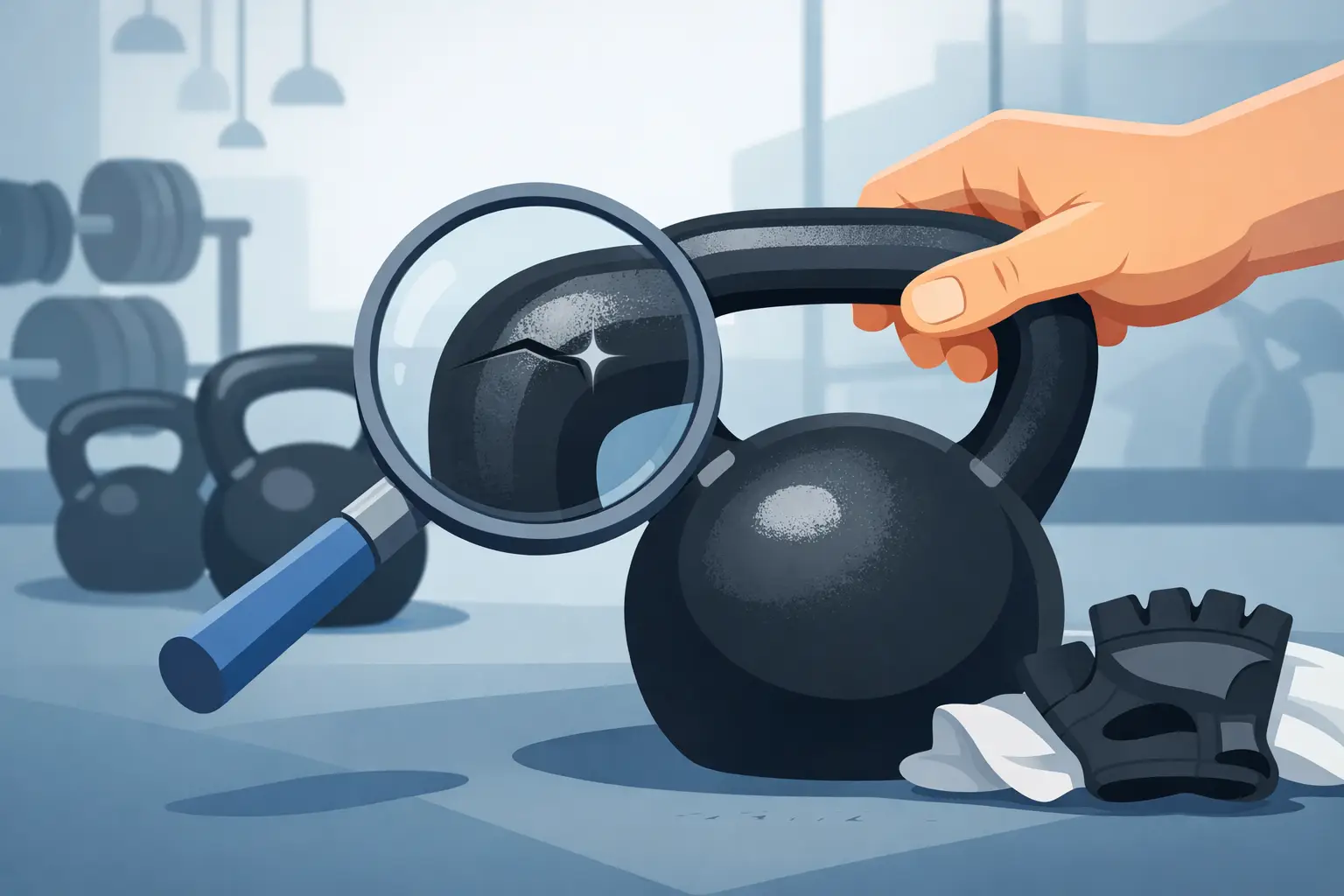
A kettlebell does not need to fail dramatically to create a problem. A rough seam can tear a palm. A slick handle can turn a controlled snatch into a chase. A cramped grip can change the rack position and load the wrist poorly. Kettlebell handle safety begins before the first rep, with the condition of the bell, the way your hand fits it, and the standards you apply when fatigue builds.
The handle is the point of contact for nearly every kettlebell movement. It transfers force during swings, supports load in the rack, rotates in the hand during cleans and snatches, and must remain predictable when you are breathing hard. Treat it as a training surface, not a detail.
Kettlebell Handle Safety Starts With Inspection
Before training, run your hand slowly around the entire handle. You are looking for anything that changes the feel of the surface: sharp casting lines, raised paint, chips, cracks, rust, or rough patches. Do not rely on a quick visual check. Small defects are often easier to feel than see.
A well-made cast-iron handle should feel solid and continuous. Minor texture is not automatically a problem. In fact, a lightly textured surface can hold chalk well. The issue is aggressive texture, an unfinished seam, or a localized ridge that repeatedly contacts the same point on your palm. Under high-rep work, a small imperfection becomes a hot spot.
Check where the handle meets the bell body as well. There should be no crack, separation, or movement. Never train with a damaged kettlebell because it "probably has a few more sessions." A handle failure during a swing, clean, or overhead lockout is not a missed rep. It is an uncontrolled load moving at speed.
Paint and coating deserve attention. A coating that flakes into the palm can compromise grip and irritate the skin. Remove loose debris, clean the handle, and retire the bell from dynamic work if the underlying surface is damaged or unstable. A bell that is safe for a slow deadlift may not be safe for ballistic training.
Fit Matters More Than Handle Diameter Alone
A kettlebell handle should give your hand enough room to move without forcing it into a cramped position. That sounds simple, but fit changes by movement, hand size, grip style, and the number of hands on the bell.
For two-hand swings, both hands should sit inside the handle window without being compressed against each other. If your knuckles, fingers, or thumbs are constantly crushed against the sides, you may alter your grip, lose power transfer, or develop unnecessary calluses. A little contact is normal. Persistent pinching is not.
For one-hand swings, cleans, presses, and snatches, the handle needs enough interior space for the hand to reposition as the bell rotates. Competition kettlebells use standardized external dimensions across weights, which creates a familiar handle position as you progress. This is useful for technical work, especially when training cleans, jerks, and snatches across multiple loads.
Hardstyle cast-iron kettlebells can vary more in handle geometry between weights and manufacturers. That is not inherently unsafe. It simply means you should assess each bell individually. A 16 kg bell and a 24 kg bell may feel meaningfully different in the hand, even when the weight jump is expected.
Handle thickness is also a trade-off. A thicker handle can challenge grip and feel secure for strong two-hand work. But if it forces a death grip during longer sets, it may accelerate forearm fatigue and make the bell harder to control overhead. A thinner handle may rotate more easily for snatches, but it can be less comfortable for lifters with large hands or those training heavy swings. There is no universal best diameter. There is only a handle that matches the movement, the load, and the athlete using it.
A Clean Handle Is a Safer Handle
Sweat, lotion, dust, and gym-floor residue change grip fast. Start with dry hands and a clean handle. Wipe the bell down after use, particularly in shared spaces, and store it away from standing water or persistent humidity.
Chalk is useful when it improves contact without creating a thick, slippery layer. Use a light application and work it into the palm. Too much loose chalk can build up on the handle and reduce consistency, especially when it combines with sweat. If you need excessive chalk to keep control of a light or moderate bell, examine your grip mechanics and fatigue management before adding more powder.
Avoid lifting straps for ballistic kettlebell work. Straps can interfere with release and recovery if the bell moves unexpectedly. They also mask a grip problem rather than helping you solve it. For controlled slow lifts, training tools have their place, but swings, cleans, and snatches demand a direct, responsive connection to the handle.
Rings, watches, bracelets, and loose sleeves create their own hazards. Remove them before training. Jewelry can catch the handle, damage the bell coating, or injure the hand when the bell rotates.
Grip Pressure Should Change Through the Rep
Many preventable handle problems begin with gripping too hard at the wrong time. A kettlebell is not a barbell. During a swing, the handle should sit deep enough in the hand to remain secure, but you do not need to crush it through every phase. Over-gripping fatigues the forearms, encourages early arm pulling, and makes the return path less controlled.
In a clean, keep the fingers responsive as the bell travels around the hand. Do not let the bell slam into the forearm because you held the handle rigidly and pulled it upward. Guide the bell into the rack. The handle should settle diagonally across the palm, with the wrist stacked and the forearm supported by the bell body.
The same principle applies to snatches. The bell should rotate around the hand, not flip over it. A hard, fixed grip creates friction. Friction creates torn skin. Torn skin changes technique, and compromised technique is where a manageable session becomes a safety issue.
Build grip tolerance gradually. High-rep snatches, long swing intervals, and dense complexes can stress the hands before the lungs or legs are the limiting factor. If the skin feels hot, the grip is failing, or the handle is starting to move unpredictably, stop the set. One extra rep is not worth a torn callus that disrupts the next two weeks of training.
Match the Handle to the Movement
Not every kettlebell session places the same demands on the handle. Heavy deadlifts and two-hand swings reward a stable, secure grip. Cleans and presses require a handle that allows a comfortable rack. Snatches, long cycle work, and high-volume conditioning require predictable rotation and a finish that does not punish the hands.
This is where equipment selection becomes practical. Competition kettlebells are built for standardized technique and consistent dimensions. They suit athletes who train technical lifts, sport-style work, or structured progression across multiple weights. Hardstyle cast-iron kettlebells are durable tools for strength, swings, carries, presses, and general conditioning, but their handle feel should be checked weight by weight.
Do not choose a bell only because the number on it matches your goal. A bell that is poorly finished, too cramped, or poorly matched to your hand is the wrong tool, regardless of its load. Incore Sports designs equipment for repeated work, but every serious trainee should still inspect every handle before use. Durable equipment deserves disciplined use.
Set Up the Training Area for Safe Releases
Handle control depends partly on the space around you. Train on a stable surface with enough clearance in front, behind, and above the body. Keep other people out of your swing path. Do not perform overhead work beneath low ceilings, fans, storage racks, or hanging lights.
Know where the bell will go if you need to end a rep. For swings, that usually means guiding it back to the floor between the feet with a neutral spine. For an overhead miss, especially during snatches or jerks, do not fight a bad position to save the rep. Release the bell into clear space and move away from its path. This requires planning. It cannot be improvised after your grip has already failed.
Shoes and flooring matter too. A slick sole or unstable mat can turn a secure handle into an unsafe lift. Your feet create the base that allows the hand to guide the bell. If the floor shifts, your grip will compensate, often too late.
When to Stop Using a Kettlebell
Remove a kettlebell from training immediately if you find a crack, handle movement, a sharp exposed edge, severe corrosion, or a coating failure that affects grip. Do not sand, weld, or modify a compromised bell unless repair is performed and approved by a qualified equipment professional. A cosmetic touch-up is different from structural repair.
You should also pause a session when your hands are torn, numb, or unable to hold the handle with control. Training through normal effort is part of the work. Training through a loss of control is not toughness. It is poor load management.
A kettlebell handle should feel predictable from the first warm-up swing to the final set. Inspect it. Clean it. Match it to the work. Then train with enough discipline to put the bell down before technique and grip turn against you. Earn your reps, and keep your hands ready for the next session.