
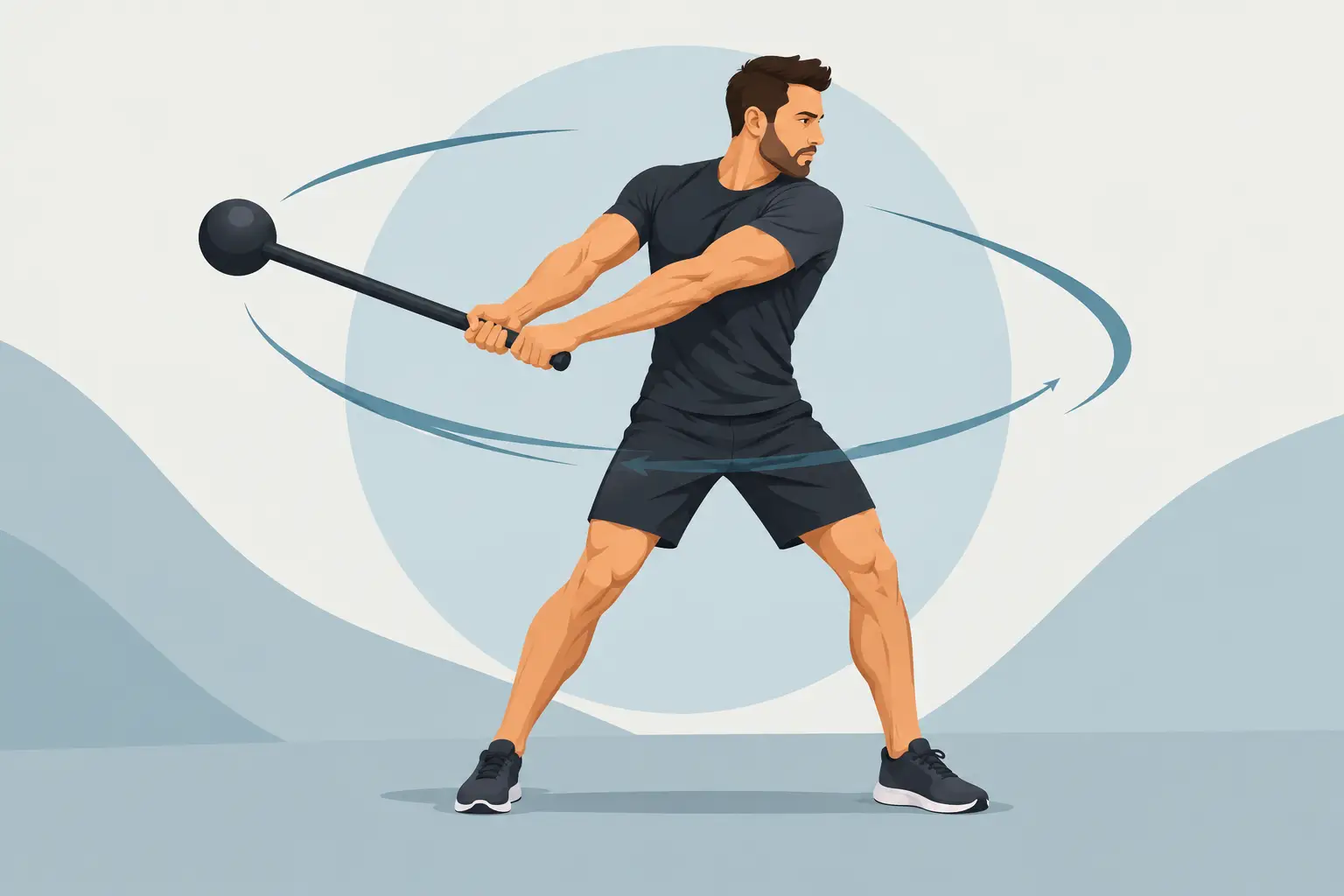
A barbell can make you strong without asking much from your rotation. Steel macebells change that equation. Their long handle shifts the load away from your hands, creating leverage that demands grip strength, shoulder stability, trunk control, and disciplined movement through every rep.
That leverage is the point. A mace is not a novelty substitute for a dumbbell or kettlebell. It is a specialized free-weight tool for training rotational power, resilient shoulders, and strength that carries into sport, physical work, and serious functional fitness. Earn your reps by respecting the tool first.
What Steel Macebells Change in Training
The head of a macebell sits at one end of a long steel handle. As the mace moves, the load pulls against your grip and challenges your ability to keep the ribs, pelvis, and shoulders organized. A relatively light mace can feel demanding because the resistance is not centered in your hand.
This makes steel macebells especially useful for movements that require controlled arcs, rotation, and deceleration. The body must guide the load around the head and back into position without losing posture. Your forearms work. Your hands work. Your upper back works. So do the muscles that prevent unwanted movement at the shoulder and trunk.
The training effect is different from pressing a symmetrical weight overhead. A press develops force in a mostly straight line. Mace work teaches you to create and absorb force as the load travels around you. Neither replaces the other. Together, they build a more complete strength base.
Steel construction matters here. A solid steel mace provides a fixed, predictable load with no moving parts and no internal shifting. That consistency helps you learn the path of each swing and track progression over time. The tool should feel secure, balanced, and ready for repeated training.
Choosing the Right Steel Macebell Weight
The common mistake is buying a mace based on what you can bench press, deadlift, or swing with a kettlebell. Those numbers do not transfer directly. The longer lever multiplies the challenge, particularly during transitions behind the head and during one-handed work.
For most new mace trainees, a 7 to 10-pound steel macebell is enough to learn fundamental patterns. Strong, coordinated lifters with healthy shoulders may begin with 10 to 15 pounds, but only if they can control the mace without rushing the swing, flaring the ribs, or bending the wrists under load. Starting lighter is not a compromise. It is how you build skill that stays useful as the weight increases.
Choose the lighter option if your main goal is mobility, shoulder control, or learning two-handed 360s and 10-to-2s. Choose a heavier option when you already own clean technique and want more demand in squats, presses, rows, lunges, and offset carries. A heavier mace is not automatically better for circular work. Once the head begins pulling you out of position, the movement has stopped serving its purpose.
Your training environment also matters. A mace needs clearance in front, behind, and above the body. Measure the area where you train before selecting a handle length and planning overhead swings. Low ceilings, crowded home gyms, and hard surfaces demand more attention, not less.
Use control as your progression standard
Do not progress because a certain number of weeks has passed. Progress when you can perform every repetition with the same path, pace, and posture. The mace should not crash into the catch position. Your neck should stay relaxed, your shoulders should remain active, and your torso should not twist or lean to rescue the rep.
Add repetitions first. Then add sets, reduce rest periods, or use more challenging grips. Increase mace weight only after the current load feels controlled across several sessions. This approach protects the shoulders and produces measurable progress instead of random hard work.
Learn the Movement Before You Chase Volume
The 360 is the movement most people associate with mace training. It can be highly effective, but it is also easy to perform poorly. The goal is not to throw the mace behind your head and hope it comes back around. The goal is to guide a controlled arc while maintaining a tall posture and a stable shoulder position.
Start with basic handling. Practice changing hand placement, moving the mace from a vertical rack to an extended position, and performing slow pendulum-style swings in front of the body. These drills teach you where the load sits and how quickly it responds to your hands.
When learning a two-handed 360, use a light load and a smooth tempo. Keep your elbows close enough to control the path, then allow them to bend naturally as the mace travels behind the head. The lower hand guides the handle. The upper hand helps steer and stabilize. Avoid yanking the mace over the shoulder with your arms alone.
The 10-to-2 pattern is often a better starting point for some trainees because it uses a smaller arc and makes the catch easier to understand. Even so, the same standards apply: stable stance, controlled grip, no painful range, and no rushed transition.
If a movement causes sharp pain, numbness, or a sense that the shoulder is unstable, stop. Fatigue is part of training. Joint pain is not a technique cue to ignore. Work with a qualified coach if you are returning from a shoulder injury or lack confidence in overhead movement.
Program Mace Training for a Clear Purpose
Steel macebells work best when they have a defined role in your program. For warm-ups, use a light mace for slow halos, controlled pendulums, and easy mobility-focused patterns. Keep the effort low and leave the session feeling more prepared, not exhausted.
For strength and skill, train two or three times per week. Use sets of three to six controlled repetitions per side for technical rotational drills, resting enough to maintain quality. For straightforward strength movements such as offset squats, rows, presses, and carries, use moderate sets and treat the mace like any other free weight: brace, move with intent, and stop before form breaks down.
Conditioning has a place, but it comes after skill. Timed intervals of swings, lunges, and carries can build a serious work capacity. They are not the right entry point for a beginner who is still learning the arc of the mace. First earn clean reps. Then earn density.
A practical weekly setup might pair mace work with your existing kettlebell, barbell, or bodyweight training. Use it after your main strength lift for focused rotational work, or place light technique practice at the start of a session. Avoid high-volume overhead mace work immediately before heavy pressing if your shoulders are already fatigued.
Handle, Grip, and Build Quality Matter
A steel macebell should feel like one piece of equipment, not a collection of parts. Solid construction supports predictable balance and repeated use. A clean finish helps protect the steel, while a grip-friendly handle gives you enough control to change hand positions without relying on excessive squeezing.
Handle diameter affects the experience. A thicker handle increases grip demand and can suit experienced trainees who want more forearm work. A more moderate diameter is often easier for beginners and for longer technical sets. There is no universal best option. The right choice depends on hand size, training goal, and the movements you plan to perform.
Do not confuse a difficult grip with productive training. You should need to hold the mace securely, but you should still be able to guide it precisely. If your hands fail long before you can maintain a safe shoulder position, reduce the load, shorten the set, or improve your hand placement.
Who Benefits Most From Mace Training?
Mace training fits athletes who rotate, strike, throw, grapple, or change direction under pressure. It also serves lifters who want stronger shoulders and grip without adding more conventional pressing volume. For coaches, it offers a practical way to expose clients to offset loading and controlled rotational patterns.
It is not mandatory for every goal. If you only need maximal barbell strength, a mace is an accessory rather than a priority. But if your training needs more movement quality, rotational strength, and shoulder control, it earns its place.
Start with a load you can command, give the basics the patience they require, and let clean repetition build the strength that heavier steel macebells demand.