
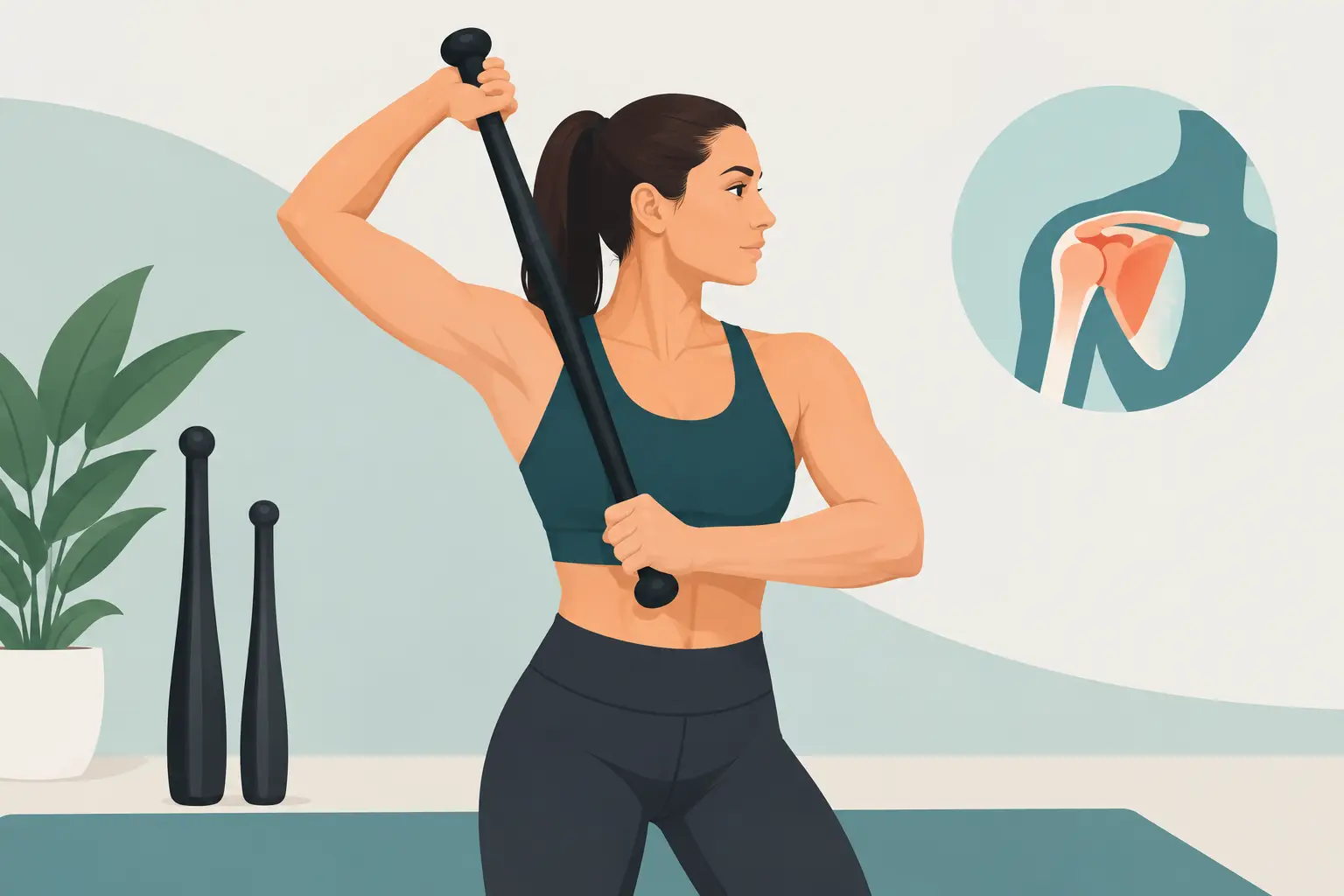
A shoulder that can press but cannot rotate, reach, or stabilize under leverage is not fully prepared for training. This clubbell mobility training guide is built for lifters who want more than passive stretching. A steel clubbell asks your joints to control a long lever through space, building usable range of motion, grip strength, and rotational control at the same time.
Clubbell work should feel deliberate, not frantic. The goal is not to throw a heavy tool around your head for high reps. The goal is to own clean positions, strengthen the transitions between them, and add load only when your movement earns it.
Why Clubbell Mobility Training Works
A clubbell places most of its mass away from your hand. That offset load creates leverage. A relatively light club can challenge the wrist, elbow, shoulder, upper back, and trunk far more than its total weight suggests.
This is why clubbell training is useful for mobility and strength work. Instead of passively pulling a joint into a range, you create tension while moving through that range. Your body learns to control the position rather than simply visit it.
The greatest payoff is usually at the shoulders and thoracic spine. Controlled casts, circles, pendulums, and mills require the shoulder blade to move with the upper arm while the rib cage stays organized. Done well, this can improve overhead comfort, pulling stability, and resilience for pressing, kettlebell work, combat sports, throwing, and field athletics.
Clubbells also expose weak links. If your wrist collapses, your grip fades, or your ribs flare every time the club moves overhead, the tool gives immediate feedback. That feedback is useful only if you respect it. Mobility training is not a contest of range at any cost.
Choose a Clubbell You Can Control
For mobility-focused work, lighter is usually smarter. Because the load sits at the end of a long lever, a 10-pound clubbell can be demanding for a beginner. Many athletes who can press heavy dumbbells are surprised by how much control a light club requires.
Start with a load that lets you perform slow, smooth repetitions without gripping for survival. For many beginners, that means a 5- to 10-pound clubbell. Stronger or more experienced trainees may begin with 15 pounds, but only if their shoulders already tolerate rotational work and they can keep the club on a predictable path.
Do not choose a clubbell based on ego or barbell numbers. A heavier club does not automatically create better mobility. It often turns a controlled circle into a rushed swing and shifts stress into the elbow, neck, or low back.
Your handle grip matters as much as club weight. Hold the handle firmly enough to prevent rotation, but do not crush it. A death grip travels up the forearm and can make the neck and shoulder overwork. Keep the wrist stacked and use the handle as a steering wheel, not a handle you need to survive.
Build the Positions Before the Patterns
Before you learn mills or complex combinations, establish a few basic positions. Stand tall with feet about hip-width apart. Soften the knees, brace the trunk, and keep your ribs stacked over your pelvis. This is your base.
The shoulder needs space to move. Avoid forcing the chest high or arching the low back to fake overhead range. If the club moves behind your head only because your ribs are flaring, you are borrowing range from the wrong place.
Start every session with several minutes of unweighted shoulder circles, scapular push-ups, controlled thoracic rotations, and wrist circles. Then rehearse the clubbell path at low speed. Your warm-up should prepare the positions you will use, not exhaust you before the work begins.
The Pendulum: Learn to Manage the Lever
The pendulum teaches the basic feel of offset load. Begin with two hands on the handle and the club under control in front of the body. Let the club travel through a short, smooth arc while your shoulders stay down and your trunk remains quiet.
Use a range you can control without jerking. The club should move because you guide it, not because you yank it with your arms. This pattern develops grip timing, shoulder packing, and awareness of where the club head is moving.
Once two-hand pendulums are steady, progress to single-arm work only if the wrist stays aligned and the shoulder remains stable. A small, clean arc is more productive than a large, loose one.
The Shield Cast: Own the Overhead Transition
The shield cast is a foundational clubbell pattern for shoulder mobility and upper-body strength. It moves the club around the head while demanding control through the overhead transition and the return to the front of the body.
Keep the movement compact at first. Maintain a tall posture, let the shoulder blade rotate naturally, and avoid snapping the neck forward as the club passes behind you. Your eyes stay forward. Your rib cage stays controlled.
If you feel a sharp pinch in the front or top of the shoulder, stop and reduce either the load or range. Mild muscular effort around the upper back and shoulder is expected. Joint pain is not a progression signal.
The Mill: Combine Rotation and Stability
A mill is a circular clubbell pattern that passes around the head and shoulder in one continuous path. It is valuable because it connects grip, wrist position, scapular movement, shoulder rotation, and trunk control. It is also technical.
Do not rush into heavy single-arm mills. Learn the path with a light club, using slow repetitions and pauses at positions where control breaks down. Many lifters benefit from practicing assisted or two-hand variations before working one arm at a time.
A good mill feels smooth and repeatable. A bad mill feels like the club is pulling you out of position. If your elbow flares uncontrollably, your torso twists excessively, or the club crashes into the catch, regress the pattern.
A Practical Clubbell Mobility Session
Train clubbell mobility two to four times per week. Short, consistent sessions work better than one long session that leaves your shoulders irritated. Use the work as a warm-up before strength training, as a stand-alone movement session, or as a low-intensity finish after lifting.
Begin with two rounds of controlled preparation: shoulder circles, thoracic rotations, wrist circles, and light bodyweight squats. Then perform pendulums for 6 to 10 repetitions per side. Follow with shield casts for 5 to 8 repetitions per side, using a controlled tempo. Finish with mills for 3 to 6 repetitions per side only if the pattern is already established.
Rest as needed between sides and sets. The target is quality movement, not conditioning fatigue. If your grip is failing before your shoulder mechanics are challenged, shorten the set. If your breathing becomes rushed, slow down.
For athletes with stiff hips or limited trunk rotation, add a light clubbell offset carry or a split-stance hold after the main work. These simpler drills teach the body to resist unwanted rotation while maintaining an organized pelvis and rib cage. They are often a better choice than adding more complicated swings.
Progress Without Losing the Mobility Benefit
Progress one variable at a time. First improve position and smoothness. Then add repetitions. After that, add another set or slightly reduce rest. Increase club weight last.
A useful benchmark is being able to complete three sets of eight controlled repetitions per side with no grip panic, no low-back compensation, and no post-session joint irritation. At that point, a modest increase in load may be appropriate.
It depends on your primary training goal. If clubbells support heavy barbell pressing, keep the mobility work light and leave several repetitions in reserve. If clubbells are a main training tool, you can gradually use more volume and longer lever patterns. Either way, do not chase fatigue at the expense of clean mechanics.
Common Mistakes That Limit Results
The first mistake is choosing too much weight. The second is treating every repetition like a conditioning drill. Fast work has a place, but speed without control teaches compensation.
Another common error is locking the shoulder blade down throughout the entire movement. The shoulder blade must move when the arm moves overhead. Keep the shoulder organized, but allow natural upward rotation instead of forcing a rigid position.
Finally, do not ignore discomfort. Muscle fatigue in the grip, upper back, and shoulders is part of training. Sharp pain, numbness, catching, or symptoms that persist after the session deserve attention from a qualified medical professional.
A clubbell rewards patience. Start light, build clean circles, and let control determine your next step. Earn your reps, and mobility becomes strength you can use.