
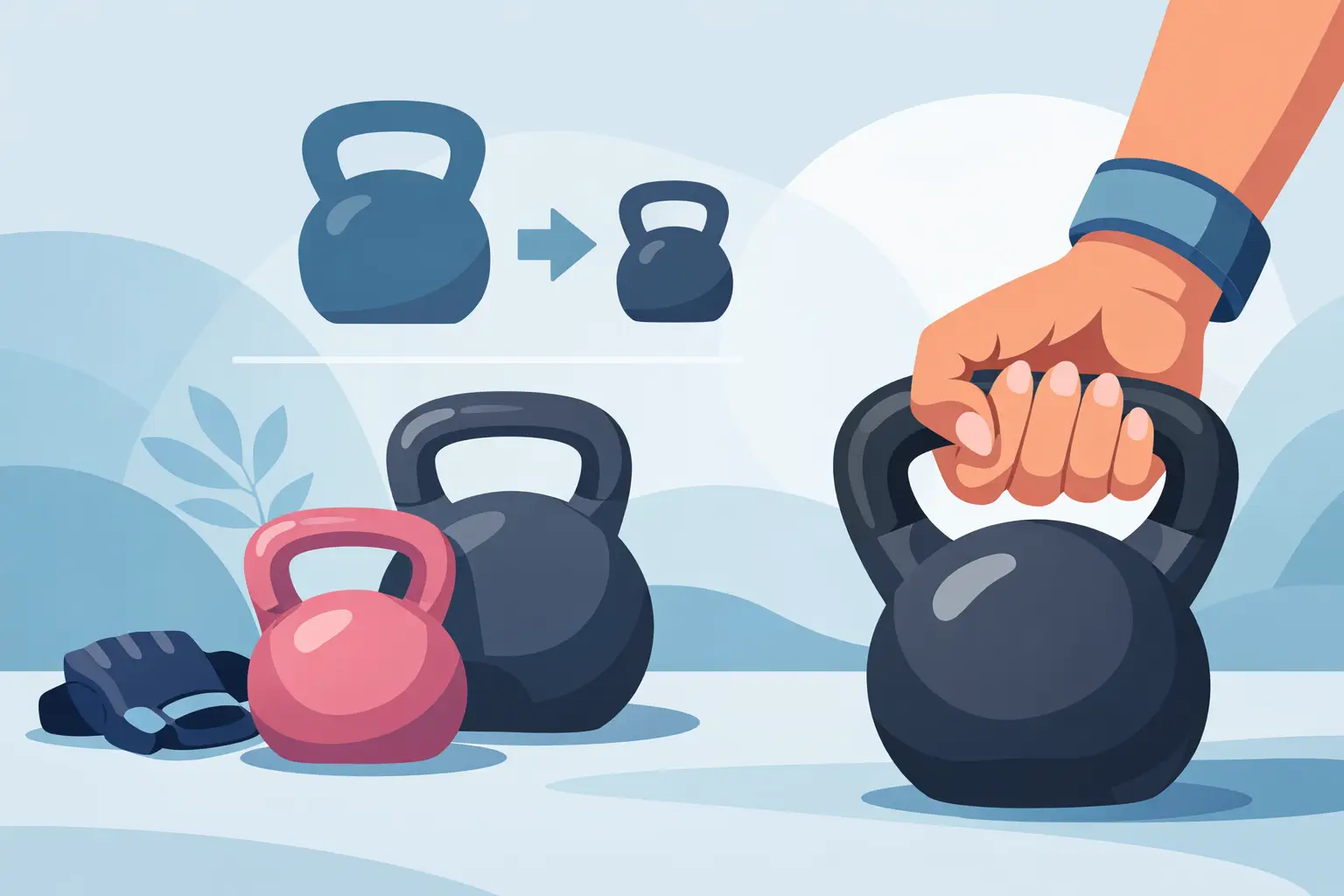
A handle that feels oversized changes the work. Your grip tires early, cleans bang into the forearm, and a simple swing becomes a fight to keep the bell secure. The best kettlebell for small hands is not simply the lightest bell on the rack. It is the bell whose handle geometry, finish, and weight let you train with control through the full session.
Small hands do not rule out serious kettlebell training. They do mean you should pay closer attention to dimensions that are often ignored in a basic buying guide. A good fit lets you build strength, conditioning, and skill without compensating for equipment that is working against you.
What Makes the Best Kettlebell for Small Hands?
Start with the handle, but do not judge it by handle diameter alone. The usable space inside the handle, the distance between the horns, the bell's balance, and the texture of the finish all affect how a kettlebell feels in motion.
A narrower handle diameter is generally easier to hold when your fingers cannot fully wrap a thick grip. For many smaller-handed lifters, a handle around 30 to 33 mm feels more manageable than a very thick, rough cast handle. But thinner is not automatically better. A handle that is too thin can feel sharp under load, especially during high-repetition swings or snatches. You want a grip you can close securely without having to crush the handle on every rep.
The window matters just as much. This is the open space beneath the handle. If the window is too narrow, your hand can feel trapped during cleans, presses, and front-rack work. If it is too shallow, the bell may sit awkwardly against the forearm. Look for enough room to insert your hand without forcing your knuckles into the horns, while keeping the bell compact enough to remain stable in the rack.
Handle shape also changes the experience. A rounded, smooth transition from handle to horn tends to move comfortably during cleans and snatches. Squared-off or sharply angled transitions may create pressure points. That does not make every cast-iron kettlebell a poor choice, but it makes inspection more important.
Competition or Hardstyle Kettlebell?
For many people with small hands, a competition kettlebell is the more predictable option. Competition bells use standardized exterior dimensions across most weights. The handle and window remain similar from lighter bells to heavier bells, while the internal construction changes to create the weight. Once you find a handle that fits, your technique does not need to adapt every time you move up in load.
That consistency is valuable for cleans, jerks, snatches, long-cycle work, and structured conditioning. The smooth steel handle is usually comfortable for repeated reps when it is properly finished. It also allows the bell to rotate in the hand more freely than a heavily textured handle. Chalk can help when needed, but excessive grip tension is not the goal.
Hardstyle cast-iron kettlebells are built for durable strength training and often suit swings, deadlifts, goblet squats, carries, and simpler pressing work extremely well. Their dimensions usually increase with weight, however. A 12 kg bell may feel excellent, while a 20 kg version from the same line may have a noticeably thicker handle and wider body. If you plan to progress through several weights, check the stated handle dimensions for each bell instead of assuming the fit will stay the same.
Neither format wins in every situation. Choose competition bells when consistent geometry and ballistic skill work are priorities. Choose quality cast iron when you prefer the traditional feel, durable one-piece construction, and a training plan built around foundational strength. Incore Sports separates these categories for a reason: construction should match the work.
Do Not Solve a Fit Problem by Going Too Light
A small handle can feel friendly in the store and still be the wrong training weight. The bell must challenge the movement without forcing a breakdown in position.
For a beginner, the right first weight depends on training history, body size, movement quality, and the exercises you will actually perform. A person who can deadlift confidently may start heavier for two-hand swings than for single-arm cleans or overhead pressing. That is normal. One kettlebell does not need to serve every movement perfectly on day one.
As a broad starting point, many new lifters use a lighter bell to learn the clean, press, and Turkish get-up, then a moderately heavier bell for two-hand swings and deadlifts. The exact kilograms matter less than the result: you should be able to maintain a neutral wrist, controlled shoulder position, and clean hip hinge. Do not buy a 32 kg bell as your first kettlebell because you expect to grow into it. Technique needs productive reps now.
If the handle feels slightly large but the bell is otherwise right, do not immediately switch to a much lighter weight. First assess whether the issue is grip technique. Beginners often hold the handle too deep in the palm and squeeze far too hard. For swings, the handle should sit closer to the fingers, allowing the bell to hinge from the hip without exhausting the forearms. For cleans, learn to guide the bell around the hand rather than letting it crash over the wrist.
Check These Dimensions Before You Buy
Product photos are useful, but measurements tell you more. Compare handle diameter, window width, and window height whenever those specifications are available. A well-built bell can still be a poor match if your hand cannot move naturally inside it.
Use this practical test when possible. Put your hand through the window as if setting up for a clean. Make a loose fist around the handle. Your knuckles should not be jammed into the horns, and your fingers should not need to stretch aggressively to meet your palm. Then hold the bell in a front-rack position. The handle should sit diagonally across the palm with the wrist neutral, not bent backward by the bell's shape.
For two-hand swings, check whether both hands can share the handle without crowding. Small hands can still benefit from a standard-width handle, but a narrow window can make high-repetition work uncomfortable. For single-arm work, prioritize clearance around the knuckles and a smooth handle finish over extra handle width.
A few buying details deserve attention:
- Avoid thick paint, peeling coatings, sharp casting seams, and rough handle edges. Grip discomfort becomes a real limitation during volume.
- Choose a flat, stable base if you will use deadlifts, rows, and floor-based training. A bell that rocks when parked is distracting and unsafe.
- Consider your next two weights, not only your first one. Consistent handle geometry supports cleaner progression.
- Use chalk sparingly for long sets or humid conditions. Gloves usually reduce feedback and can make the handle feel bulkier.
Train the Grip Without Letting It Dominate Every Rep
The goal is not to eliminate grip work. Kettlebells build it naturally. The goal is to ensure the handle is challenging your grip in a useful way rather than forcing strain in the fingers, wrist, or elbow.
During swings, think of your hands as hooks. The hips move the bell. During cleans and snatches, relax the hand at the right moment so the handle can rotate instead of tearing at the skin. During presses and carries, close your grip with intent, but keep the wrist stacked over the forearm. These details matter more when your hand has less room inside the window.
Build volume gradually. Start with short sets that leave your hands and forearms fresh enough to preserve technique. If you develop hot spots, first look at your hand placement and the finish of the handle. A little callus development is part of training. Blisters, wrist pain, and repeated forearm impacts are signals to adjust the setup.
Choose the Bell You Will Use Consistently
The right fit should disappear once the set begins. You should be thinking about hip drive, breathing, rack position, and rep quality, not whether your fingers can stay on the handle.
If you have small hands, favor a kettlebell with a manageable handle diameter, adequate window clearance, and a smooth, durable finish. Match its construction to your training goal, then select a weight that lets you own the movement. A well-fitted bell does not make training easy. It makes every hard rep count.