
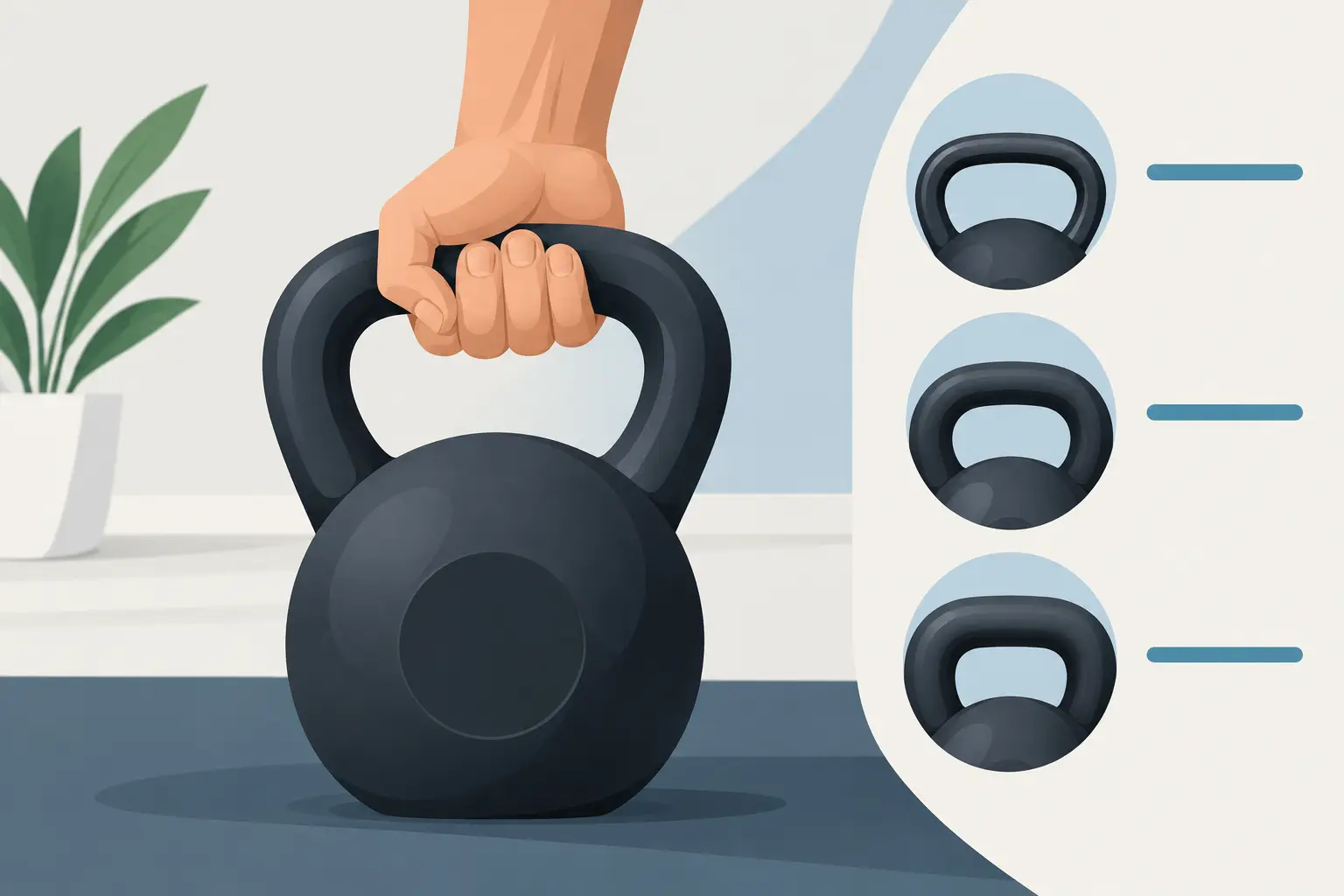
A kettlebell can have the right weight and still feel wrong in your hands. The cause is often kettlebell handle sizing. A handle that is too narrow can crowd the grip. One that is too thick can limit control and fatigue the forearms early. A poorly shaped window can make the rack position uncomfortable before your legs, hips, and lungs have done any meaningful work.
Handle size is not a cosmetic detail. It affects how the bell moves through swings, cleans, presses, snatches, carries, and get-ups. Choose the handle for the training you will actually do, not only for the number stamped on the bell.
Why Kettlebell Handle Sizing Matters
The handle is your connection to the load. Its width, diameter, window dimensions, and surface finish determine how securely you can control force during ballistic and grinding work. These details matter most when fatigue builds and technique has to hold.
A handle needs enough internal space for your hand without forcing your fingers into a cramped position. It also needs enough clearance for clean hand insertion during snatches and cleans. If your knuckles repeatedly strike the sides of the window, or your grip feels twisted at the top of a press, the bell may not fit your hand or training style.
Sizing also changes how a kettlebell sits on the forearm in the rack. A larger window can make it easier to rotate the hand around the handle, while the bell body and handle geometry determine whether the load settles securely or pulls the wrist backward. There is no single ideal size for every lifter. Hand size, grip strength, mobility, and exercise selection all matter.
The Dimensions That Define a Kettlebell Handle
Handle diameter
Handle diameter is the thickness of the grip. A thinner handle is easier to wrap with smaller hands and can feel more secure for high-repetition snatches. It may also concentrate pressure in the palm and fingers during long sets.
A thicker handle demands more grip strength. That can be useful for carries, deadlifts, swings, and general strength work, but it is not automatically better. When the handle is too thick for the user, the hand cannot close efficiently. Grip becomes the limiting factor before the intended muscles receive enough work.
For most general training, the best diameter is one that lets the fingers close firmly around the handle without forcing the thumb and fingertips into an awkward overlap. You should be able to maintain control with a relaxed but secure grip. Death-gripping every rep is not a sign of toughness. It is usually a sign that something in the setup needs attention.
Handle width
Handle width is the distance across the inside of the handle. It determines whether you can comfortably use one hand, two hands, or both.
For two-hand swings, a wider handle gives both hands room to work without crushing the fingers together. This matters for powerful hip-hinge training, especially as kettlebell weight increases. A narrow handle can still work for swings, but it may force an uneven grip or make hand transitions slower.
For one-hand work, excessive width can create its own problem. If the hand sits far from the center of the bell, the load may feel less connected during cleans and presses. The goal is not the widest possible handle. The goal is enough room for your hand position without wasted space.
Window height and shape
The window is the open area between the handle and the bell body. Its height affects knuckle clearance, hand insertion, and the path of the bell during cleans and snatches.
A tall, open window often helps larger hands move freely. It can also make it easier to release and regrip during long-cycle work. But a large window alone does not guarantee comfort. The shape of the bell body and the angle at which the handle meets the bell influence how the kettlebell rests against the forearm.
A compact window can feel stable for some lifters and exercises, particularly with traditional cast-iron designs. For others, it can feel restrictive during overhead work. Test the rack position when possible. The bell should settle on the forearm with a neutral wrist, not force you to bend the wrist back to keep it in place.
Handle finish
Finish is part of functional sizing because it changes how the handle feels in the hand. A smooth powder-coated handle often supports controlled rotation for cleans and snatches. A rough finish can improve perceived grip during heavy pulls but may create hot spots in high-volume work.
Avoid choosing a handle solely because it feels aggressively textured in the store. The same texture can become abrasive after 100 swings. Chalk can improve control, but it cannot fix an uncomfortable handle shape or a finish that tears the skin.
Competition vs. Hardstyle Handle Dimensions
Competition kettlebells use standardized external dimensions across many weight increments. A 12 kg bell and a 24 kg bell generally share the same handle and body size, with weight changing through the construction of the bell. This consistency is valuable for technical training. Your hand position, rack geometry, and swing path remain familiar as you progress.
That makes competition bells a strong choice for kettlebell sport, high-repetition snatches, clean and jerk practice, and athletes who value repeatable mechanics. They also make progression easier to measure because moving up in weight does not require adapting to an entirely new handle size.
Hardstyle cast-iron kettlebells usually increase in overall size as the weight increases. Their handles may become wider or thicker on heavier bells, although exact dimensions vary by manufacturer. This can suit heavy swings, deadlifts, carries, and general strength work, where a more substantial grip may be part of the training demand.
The trade-off is adaptation. A 16 kg cast-iron bell may feel very different from a 24 kg bell beyond the additional load. That is not necessarily a flaw. It is simply a design characteristic that matters when planning your progression.
Match the Handle to Your Training
If you mainly train swings, goblet squats, deadlifts, and carries, prioritize a durable handle with enough width for a comfortable two-hand grip. A slightly thicker handle can be useful if grip strength is part of the goal, provided it does not force poor hand position.
If cleans, presses, snatches, and long sets are central to your program, prioritize window clearance, a predictable rack position, and a finish that allows the bell to rotate without tearing the hand. Competition-style dimensions are often the most consistent option for this work.
For small hands, do not assume you need the lightest bell with the smallest handle. You need a handle that allows a complete, confident grip and clean insertion into the window. For larger hands, avoid squeezing into a restrictive window just because the load is appropriate. Technique should not be compromised by equipment geometry.
Coaches and facilities should consider handle consistency across the full rack. Mixed handle shapes make group instruction harder, especially when athletes are learning cleans and snatches. Standardized equipment reduces unnecessary variables. The athlete still has to earn the reps, but the tool should not create avoidable obstacles.
A Quick Fit Check Before You Train
Use a few controlled movements to assess fit. Start with a two-hand deadlift and swing setup. Your hands should sit naturally without pinching. Then perform a one-hand rack hold. The wrist should remain close to neutral, and the bell should rest on the forearm without painful pressure against the wrist joint.
Next, practice several slow cleans. Your hand should be able to rotate around the handle while the bell rolls into the rack, rather than slamming over the knuckles. Finally, press the bell overhead. If you must constantly readjust your hand to maintain control, assess the handle dimensions before blaming your mobility or strength.
Some discomfort is normal when learning kettlebell skills. Repeated bruising, severe skin damage, wrist pain, or numb fingers are not. Review your technique first, then inspect the handle fit and finish. Good equipment supports sound practice. It does not replace it.
Do Not Size the Handle in Isolation
The right handle cannot rescue the wrong kettlebell weight. A perfectly sized 32 kg bell is still a poor first choice for most beginners. Start with a load you can control through clean reps, then progress with purpose.
At the same time, do not accept a poor fit because the weight is correct. A kettlebell is a training tool that must move with you through thousands of repetitions. At Incore Sports, that principle guides the difference between standardized competition bells and durable hardstyle designs.
Choose the handle that keeps your grip secure, your wrist stacked, and your technique repeatable. Then train with intent. Earn your reps.