
A kettlebell that sits unused in a corner is not a bargain. A bell that matches your training, fits your hand, and gives you room to progress is. This gym kettlebell buying guide cuts through the usual confusion: competition or cast iron, light or heavy, smooth handle or coated finish, one bell or a full set.
The right choice depends on the work you expect it to do. Swings, cleans, presses, squats, carries, snatches, mobility drills, and demanding conditioning sessions all place slightly different demands on the equipment. Buy for the training you will repeat, not the most impressive number stamped on the side.
Gym Kettlebell Buying Guide: Start With Your Goal
Start with the outcome. If your priority is general strength and conditioning, a durable cast-iron kettlebell is often the direct answer. It handles swings, goblet squats, deadlifts, presses, rows, and carries without asking you to adapt your program to the tool.
If you train kettlebell sport, practice high-repetition snatches and jerks, or want a consistent rack and overhead position as loads increase, choose competition kettlebells. Their external dimensions stay standardized across the range. A 12 kg and a 24 kg bell occupy the same space in the rack, so your technique does not need to change as dramatically when you move up in weight.
This distinction matters in a gym setting. A facility running group classes may benefit from both styles. Cast iron gives members a familiar, rugged bell for broad strength work. Competition bells give coaches consistent geometry for technical drills, high-volume sessions, and serious progression. One is not universally better. Each is built for a different job.
Choose Cast Iron for Durable General Training
Hardstyle cast-iron kettlebells are the workhorses of strength training. Their solid construction and traditional shape suit explosive swings, controlled presses, loaded carries, and practical full-body training. They make sense for home gyms, personal-training studios, and commercial facilities where bells will see repeated use by many hands.
Look for a one-piece casting with no weak joint between the handle and body. A quality bell should feel balanced through the swing, sit securely on the floor, and tolerate years of contact, chalk, and hard sessions. Small cosmetic marks are not the issue. Structural integrity and dependable handling are.
Choose Competition Bells for Standardized Technique
Competition kettlebells use a steel shell and a uniform body size. That predictable shape is their advantage. The bell rests in a more consistent position against the forearm and chest during cleans, rack work, jerks, and snatches. For athletes building volume or coaches teaching repeatable mechanics, that consistency earns its place.
The trade-off is simple: competition bells are specialized. They are excellent for technical kettlebell practice and conditioning, but some lifters still prefer the more traditional feel of cast iron for heavy swings and foundational strength work. Your program decides.
Pick a Weight You Can Control
Starting weight is where many buying decisions go wrong. A kettlebell must be heavy enough to challenge the hips and trunk, yet light enough to preserve positions and timing. The correct first bell is not a test of ego. It is a tool for accumulating quality reps.
For many untrained adults, 8 kg to 12 kg provides a sensible entry point for learning hinges, goblet squats, deadlifts, and basic carries. Many men with some training experience can begin their foundational work with 12 kg to 16 kg. Many women with previous strength training may find 12 kg to 16 kg appropriate. These are starting ranges, not rules.
Your current strength, movement skill, injury history, and intended exercises matter more than sex alone. A strong barbell lifter may swing a heavier bell safely but still need a lighter option to learn the clean or snatch. A beginner may deadlift 20 kg confidently while needing 8 kg for a strict press. Different movements require different loads.
Do not buy a 32 kg kettlebell as your first bell because you expect to grow into it. You may grow around it instead, avoiding presses, cleans, and longer conditioning work because the load is too great to control. Progress comes from repeatable training.
For a single-bell setup, choose the weight that allows crisp deadlifts, swings, goblet squats, rows, carries, and at least some controlled pressing practice. For a more complete setup, build a ladder of loads. Smaller jumps are useful for presses and technical work, while larger bells serve swings, deadlifts, squats, and carries.
Handle Design Decides How the Bell Feels
The handle is your point of contact. If it is poorly shaped, overly thick, rough, or cramped, every rep becomes less precise. This matters most during cleans, snatches, and high-repetition work, where the bell must rotate smoothly around the hand rather than slam into the wrist.
A good handle offers enough internal space for a secure grip without forcing the knuckles together. Wider is not always better. An oversized handle can make one-hand work awkward, while a handle that is too narrow limits grip changes and makes two-hand swings uncomfortable. The right fit depends partly on hand size, but purposeful proportions matter more than novelty features.
Finish also affects control. Powder-coated and e-coated surfaces generally offer reliable grip with or without chalk, while smooth competition handles allow the hand to rotate during snatches and long-cycle work. Neither finish eliminates the need for technique. Death-gripping the handle is still a fast route to torn calluses and early fatigue.
For a shared gym, inspect handles regularly. Chalk buildup, damaged coating, sharp casting seams, and loose equipment all reduce training quality. Equipment should support hard work, not create avoidable distractions.
Buy the Right Quantity for the Space
One kettlebell can deliver serious training. A single bell covers hinges, squats, presses, rows, carries, get-ups, and conditioning circuits. It is the right first purchase for a home trainee who needs versatility without filling a room with equipment.
Pairs become valuable when your strength and control justify them. Double front squats, double cleans, presses, lunges, and loaded carries demand more total-body tension and expose side-to-side weaknesses quickly. They also require better rack mechanics and more available space.
For commercial gyms and studios, the buying question changes from “What can one person use?” to “What can the room support?” Stock enough lighter bells for instruction and enough middle-to-heavy bells for meaningful progression. A rack filled only with light kettlebells limits stronger members. A rack filled only with heavy kettlebells prevents beginners from learning safely.
A practical facility range usually includes several lighter options for skill work, multiple mid-range bells for the bulk of classes, and heavier bells for swings, carries, squats, and advanced athletes. Duplicate popular weights. In group training, a single 16 kg bell can become a bottleneck faster than expected.
Check Construction Before Color or Marketing
Premium equipment earns its cost through repeated use. Examine the basics: clear weight markings, a stable flat base, balanced construction, a durable finish, and a handle free from sharp edges or visible flaws. These are not luxury details. They affect safety, storage, cleaning, and daily training.
The base deserves attention. A stable kettlebell is easier to park between sets and more reliable for exercises that start from the floor. It also reduces unnecessary wobble on gym flooring. Still, avoid treating a kettlebell like a drop-tested bumper plate. Controlled placement protects the bell, the floor, and everyone nearby.
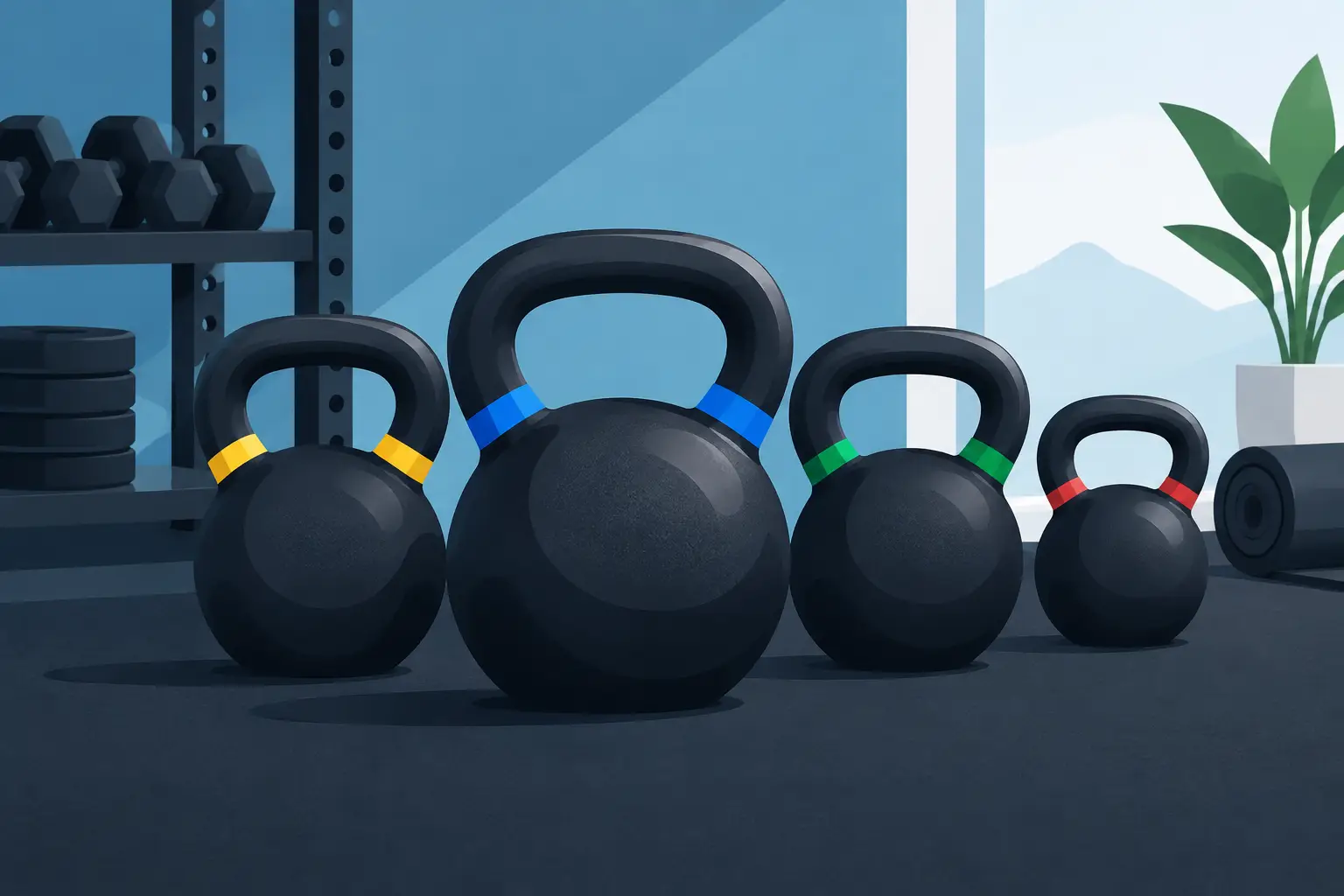
Color coding can help a busy facility identify loads quickly, especially when members rotate through stations. It should not be the primary reason to buy. Construction, weight accuracy, intended use, and handle design come first.
Make the Purchase Fit Your Next Year
Before buying, answer four practical questions: What movements will this bell perform most often? What load can I control now? What is the next sensible weight after that? Will I eventually need matching pairs?
Those answers prevent random purchases. They also create a progression path. A lifter focused on strength may add heavier cast-iron bells for swings and carries. A technical athlete may build a competition set in measured increments. A coach may combine both, matching each bell to the purpose of the session.
Incore Sports builds equipment around that principle: purposeful tools for purposeful training. Choose the bell that lets you train hard, move well, and add reps or load without compromising the standard.
The best kettlebell is the one you can return to tomorrow with better technique than you had today. Start with a load you respect, train it consistently, and earn the next bell.