
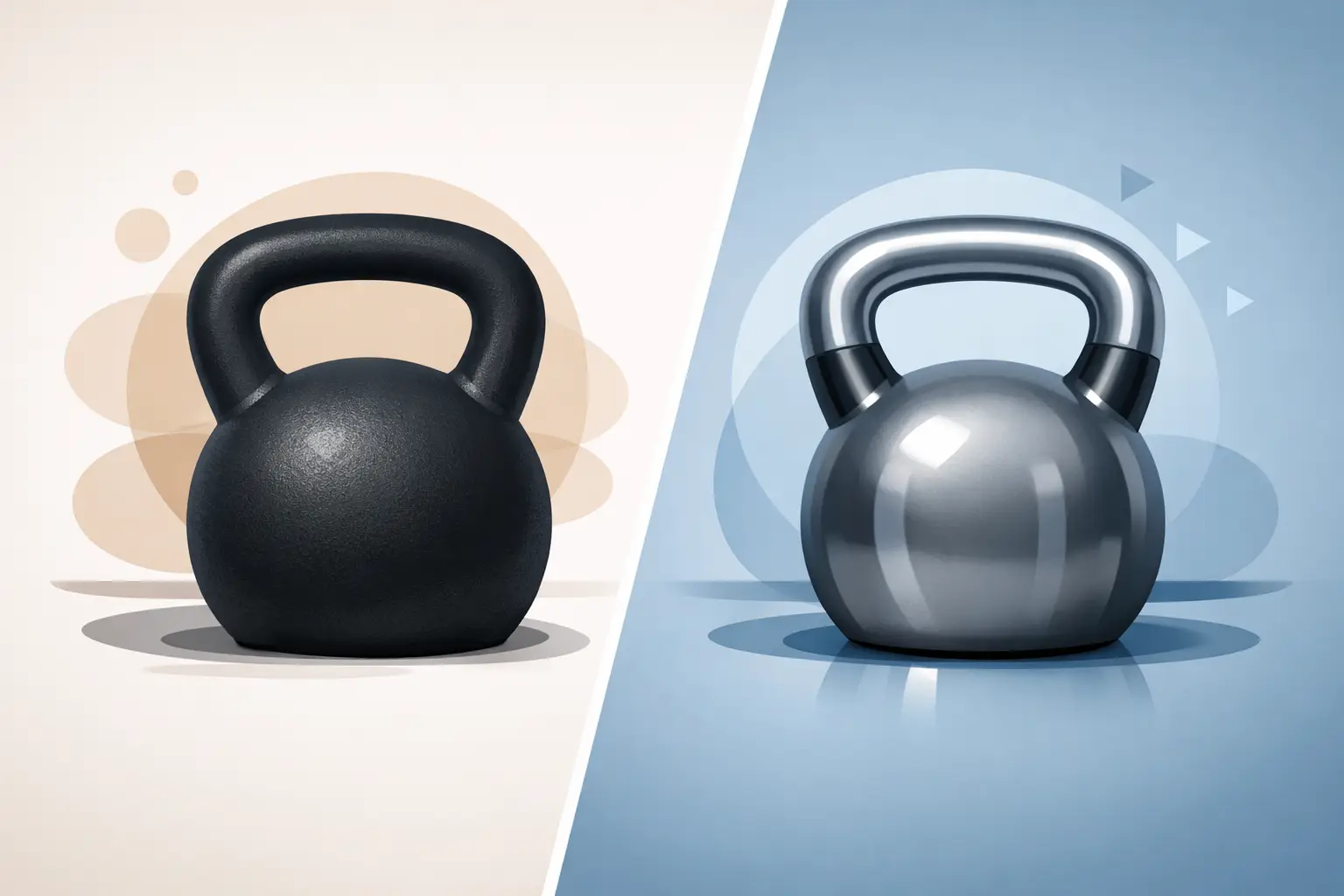
A 16 kg bell should not feel like a mystery in your hands. Yet cast iron vs steel kettlebells is a common source of confusion because the material changes more than appearance. It affects the bell’s dimensions, handle position, rack comfort, training style, and the way you progress over time.
The simple answer is this: cast iron kettlebells suit rugged general strength training, while steel competition kettlebells suit technical consistency and kettlebell sport-style work. Neither is automatically better. The right choice depends on what you train, how often you train, and whether standardized dimensions matter to you.
Cast Iron vs Steel Kettlebells: The Core Difference
A hardstyle kettlebell is typically cast from a single piece of iron. As the weight rises, the bell gets physically larger. A 12 kg cast iron bell is smaller than a 24 kg bell, and its handle, body, and window scale with it. This is the classic kettlebell design most people picture.
A competition kettlebell is usually made from steel and follows a standardized external size. A 12 kg competition bell and a 24 kg competition bell have the same outer dimensions. The weight changes through the amount and distribution of material inside the shell, not by making the bell larger.
That construction difference changes your training experience. With cast iron, a heavier bell often feels larger and more imposing in the rack. With competition steel, the rack position and handle geometry stay familiar as you move up in weight.
Cast Iron Kettlebells: Built for Hardstyle Strength
Cast iron kettlebells are direct, durable tools for swings, cleans, presses, squats, carries, rows, and get-ups. Their design supports the hardstyle approach: powerful reps, deliberate tension, and strength built through clean progression.
Because the body grows with the weight, a cast iron bell gives clear physical feedback. Moving from 16 kg to 20 kg is not only a load increase. The bell may sit differently on the forearm, require more control in the clean, and ask more from your rack position. That is not a flaw. For many strength-focused athletes, it is part of the challenge.
The handle feel
Cast iron handles can vary more between brands and weight sizes than competition handles. A quality bell should have a smooth, functional handle with enough room for secure two-hand swings and confident single-hand work. Poorly finished handles, thick seams, or sharp edges will punish your hands long before your lungs or legs are challenged.
The handle on a hardstyle bell is often wider than a competition handle. This works well for two-hand swings, deadlifts, suitcase carries, and grip-intensive work. Lifters with larger hands may prefer the extra space. For high-volume snatches, though, a wide handle can create more movement in the hand and more friction if your technique is not sharp.
When cast iron is the better choice
Choose cast iron if your training centers on foundational strength, home-gym conditioning, and practical full-body work. It is a strong fit if you want a bell that can handle years of swings, presses, goblet squats, and carries without needing competition-specific dimensions.
It also makes sense for lifters building a simple progression path. A 12 kg, 16 kg, 20 kg, and 24 kg cast iron lineup covers a great deal of ground for most adults. Do not make the mistake of buying a 32 kg kettlebell as your first bell. Heavy bells earn their place after you own the movement quality to control them.
Steel Competition Kettlebells: Made for Consistency
Steel competition kettlebells were built around repeatability. Their standardized shell allows the same technique across multiple weights. This matters when training long sets, frequent cleans, snatches, jerks, and sport-style cycles where small changes in position become costly.
The bell rests in a more predictable rack because the body and handle sit at the same height regardless of load. If your 16 kg rack is efficient, your 20 kg and 24 kg rack should require the same basic structure. The load gets heavier, but the shape does not suddenly change the task.
Why standard size matters
A consistent bell size reduces variables. Your hand insertion, elbow position, forearm contact point, and overhead lockout remain more familiar during progression. That can make steel competition kettlebells especially useful for coaches, athletes training technical lifts, and anyone working with higher rep counts.
The handle is usually narrower and more uniform than on a hardstyle bell. It supports smooth hand transitions during cleans and snatches. Some lifters also find the competition body more comfortable in the rack because the mass is shaped to sit close to the forearm and torso.
That said, a competition bell is not only for kettlebell sport athletes. It is a practical choice for functional fitness training, conditioning circuits, and home lifters who value a predictable feel as they add load. If you plan to own several weights and train cleans, presses, and snatches regularly, standard dimensions are a real advantage.
Finish, Durability, and Maintenance
Material is only one part of build quality. A poorly finished steel bell is still a poor training tool, and a well-made cast iron bell can serve for decades.
Cast iron bells commonly use powder coating, e-coating, or a painted finish. Powder-coated handles often provide a balanced grip for strength work: secure without being overly abrasive. E-coat is smoother and can work well for high-rep training, though some athletes prefer a little more texture for heavy swings and carries.
Competition kettlebells are often powder coated or painted, with a smooth handle designed for controlled hand movement. Chalk can improve grip when humidity, sweat, or volume becomes a factor. Avoid treating any finish as indestructible. Repeated drops onto concrete, poor storage, and metal-on-metal impacts will eventually mark the surface of any bell.
For both styles, inspect the handle and coating regularly. Keep bells dry, remove chalk buildup when needed, and train on flooring that protects both the equipment and the floor beneath it. Durable equipment deserves disciplined care.
Which Kettlebell Fits Your Training?
The decision comes down to purpose, not prestige. Cast iron is the better default for many strength trainees. It is versatile, straightforward, and ideal for powerful basics. Steel competition bells are the better fit when technical repetition, standardized feel, and long-set efficiency matter most.
A beginner can use either style successfully. The more useful question is what you intend to practice for the next year. If you want swings, squats, presses, carries, and general athletic conditioning, start with a quality cast iron bell. If you are drawn to clean and jerk complexes, snatch volume, timed sets, or competition-style technique, start with a steel competition bell.
Your available space matters too. Cast iron bells become larger as they get heavier, which can make storage feel more substantial in a compact home gym. Competition bells occupy a consistent footprint from one weight to the next, making a growing set easier to organize.
Do You Need Both?
Not at first. One quality kettlebell, used consistently, beats a collection of tools that gather dust. Build movement skill and strength before adding variety.
Over time, owning both can make sense. Use cast iron for heavy swings, carries, strength circuits, and raw hardstyle work. Use competition bells for technical practice, longer complexes, and volume-based conditioning. The tools overlap, but their strengths are different.
Do not let the material decide your effort. Choose the bell that matches the work in front of you, learn to own every position, and progress only when your reps stay sharp. Earn your reps.