
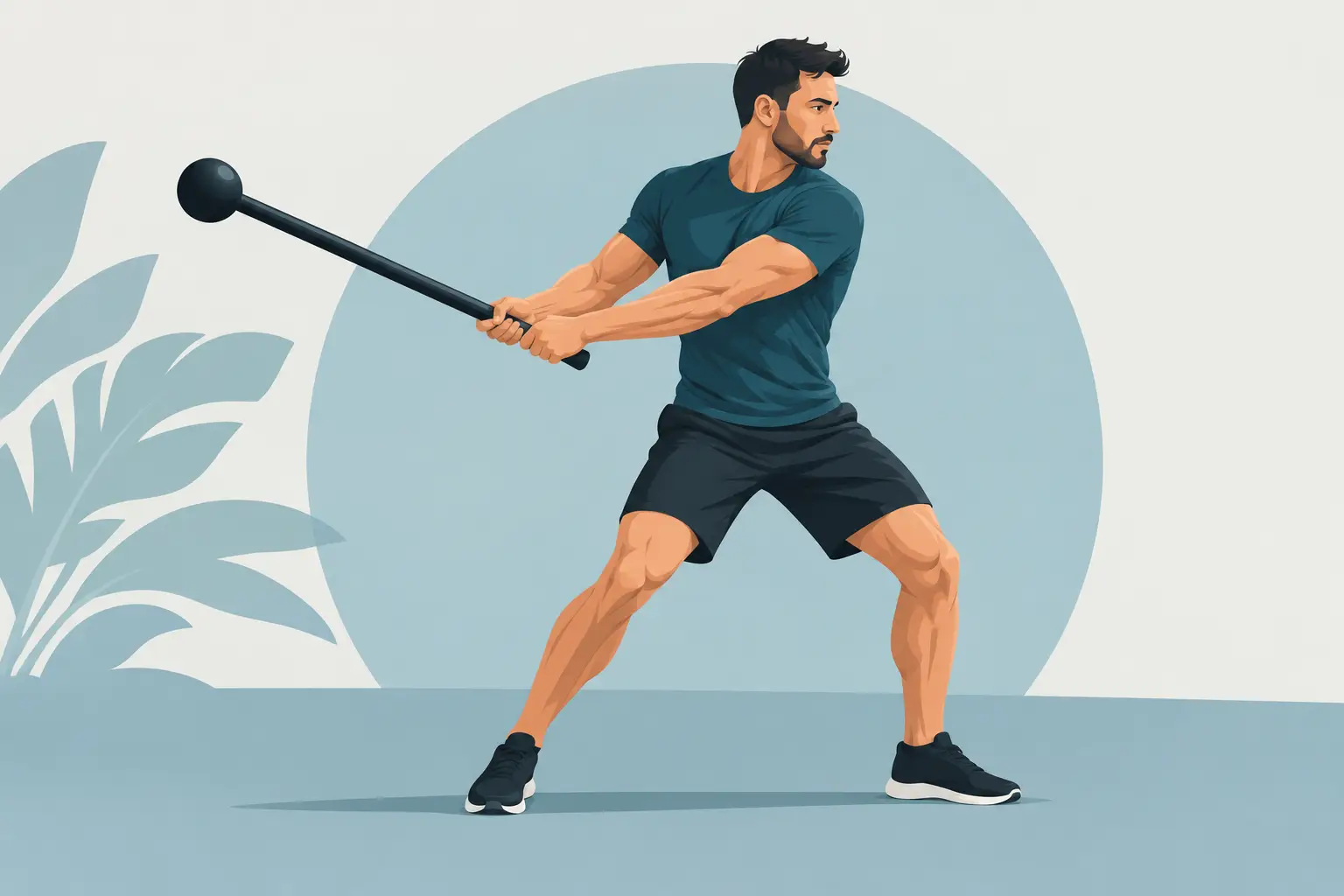
A steel mace changes the rules of loading. With most of the weight positioned far beyond your hands, a modest load can demand serious control from your grip, shoulders, trunk, and hips. That long lever is the point. Steel mace training challenges your ability to create force, resist force, and move with precision when the load is not conveniently centered.
It is not a novelty tool and it is not simply a kettlebell with a longer handle. Used well, the mace develops rotational strength, shoulder resilience, coordination, and conditioning. Used carelessly, it can turn a simple movement into a poor-quality swing. Earn your reps by starting lighter than your ego suggests and making every position deliberate.
What a Steel Mace Trains
The defining feature of a steel mace is its offset load. The weighted head creates torque around the hands, wrists, elbows, shoulders, and torso. Your body must constantly manage that torque, particularly as the mace moves away from your centerline.
This makes the tool valuable for rotational patterns. Exercises such as the 360, 10-to-2, uppercut, barbarian squat, and offset press ask the trunk to transfer force between the ground and the hands. The goal is not to twist wildly. The goal is to rotate with control, then brace at the right moment.
Shoulder mobility is another major benefit, but mobility work does not mean passive stretching. A mace can train active range of motion under manageable load. As the head travels around the body, the shoulder complex must coordinate while the rib cage and pelvis stay organized. That combination can expose weak positions that bilateral barbell work does not always reveal.
Grip strength comes with the territory. The lower hand acts as a pivot while the upper hand guides and applies force. Small adjustments in hand position change the leverage immediately. Over time, this can build stronger hands and forearms, but it also means tired grip can quickly degrade technique. Stop a set when the handle starts moving unpredictably.
Steel Mace Work Is Not Just for Shoulders
The shoulders receive attention because the mace travels around them, but the hips and trunk drive much of the work. A clean 360 is not an arm circle. It begins with a stable stance, controlled hip rotation, a braced torso, and relaxed shoulders that can move through the required path.
This is why steel mace training fits athletic conditioning. Field and court sports involve accelerating, decelerating, changing direction, and transmitting force across the body. A mace will not replace sprinting, jumping, throwing, or sport practice. It can, however, strengthen the rotational link between the lower body and upper body while demanding grip and positional awareness.
For general strength trainees, the mace also adds variety without adding random complexity. It can be used for warm-up work, loaded mobility, strength circuits, carries, presses, squats, and rotational conditioning. The correct use depends on the training goal. A heavy mace can build strength in controlled presses and squats. A lighter mace is often better for skill practice and continuous-flow work.
Choosing a Steel Mace Weight
The right starting weight depends on training history, shoulder mobility, grip strength, and whether you are learning overhead rotational skills. Do not choose based only on your barbell numbers. A strong lifter can still be new to leverage-based loading.
For many beginners, an 8 to 10-pound mace is a sensible starting point for technique work. Smaller or less experienced trainees may benefit from 5 to 7 pounds. Larger, experienced lifters with strong shoulders and a background in kettlebells, clubs, or athletic training may start with 10 to 15 pounds, but only if they can control basic patterns without compensating.
The 360 is the movement that usually exposes an overly ambitious first purchase. If you cannot guide the head behind your body without leaning back, flaring the ribs, or yanking the handle with your arms, the mace is too heavy for that drill right now. That does not mean the tool is useless. You may still use it for carries, squats, deadlifts, rows, or two-hand presses while building toward rotational work.
Handle length matters as much as the number stamped on the head. A longer handle creates more leverage and increases the demand for control. This is why a steel mace can feel challenging even when the total weight appears light. It also explains why moving from one mace size to another is not always a simple linear progression.
A practical setup includes one mace for technique and flow, then a heavier option for foundational strength work. If you train in a limited home space, measure your ceiling height and clear a full radius around your body before attempting any overhead movement. Mace training needs room. Walls, lights, furniture, and training partners do not move out of the way fast enough.
Learn the Core Positions Before the 360
Before attempting continuous rotations, own the positions that support them. Start with a two-hand front hold, keeping the wrists neutral, elbows soft, and ribs stacked over the pelvis. From there, practice controlled pendulums and switches in front of the body. These drills teach the feel of the offset head without sending it behind your shoulders.
Next, use a supported partial range. Bring the mace toward one shoulder, pause, and return to the front hold. Work both sides. The pause matters because it reveals whether you are controlling the weight or simply surviving the swing.
When you begin a 360, use a light mace and a calm tempo. Start from the front, guide the head to one side, allow it to travel behind the shoulders, and pull it back to the front with a stable trunk. Keep the movement close enough to your body that you can control it, but do not force the handle into your neck or upper back. The path varies slightly with individual shoulder structure and mobility.
Common errors are predictable: leaning backward, losing abdominal tension, gripping too hard, allowing the elbows to flare without control, and rushing the return to the front. Fix the position before adding speed. More repetitions with poor mechanics only teach poor mechanics faster.
If you have current shoulder pain, a history of instability, or cannot raise your arms overhead comfortably, do not use the 360 as self-rehabilitation. Choose pain-free strength work and seek qualified clinical or coaching guidance when needed.
Build Steel Mace Training Into a Real Program
A mace works best when it has a clear role. For a warm-up, use light controlled patterns for five to ten minutes before strength training. Focus on front holds, shield casts, shoulder-oriented partial ranges, and easy switches. The goal is preparation, not fatigue.
For strength, pair stable lower-body movements with the mace's offset load. Goblet-style squats, split squats, deadlifts, rows, and presses can all be performed with a mace when the load and grip are appropriate. Use lower repetitions, clean positions, and enough rest to keep the leverage honest.
For conditioning, choose simple movements that remain crisp under fatigue. A short circuit of two-hand swings, reverse lunges, front holds, and controlled 10-to-2 repetitions can challenge the whole body without becoming chaotic. Keep rotational skills out of all-out fatigue sessions until you have built reliable mechanics.
Two or three mace sessions per week are enough for most lifters. Place demanding rotational work before heavy pressing if shoulder quality is a priority, or use light technique practice on separate days. Progress by improving range, control, total quality repetitions, or density before jumping to a heavier mace.
Train the Lever, Not the Trick
A steel mace rewards patience. The impressive movements are useful only when they rest on strong hands, organized shoulders, stable ribs, and purposeful hip rotation. Start with the positions you can own, use a load you can control, and let repetition build the skill.
The mace head will always try to pull you out of position. Your job is to become harder to move. That is rotational power, mobility, and strength earned one clean rep at a time.