
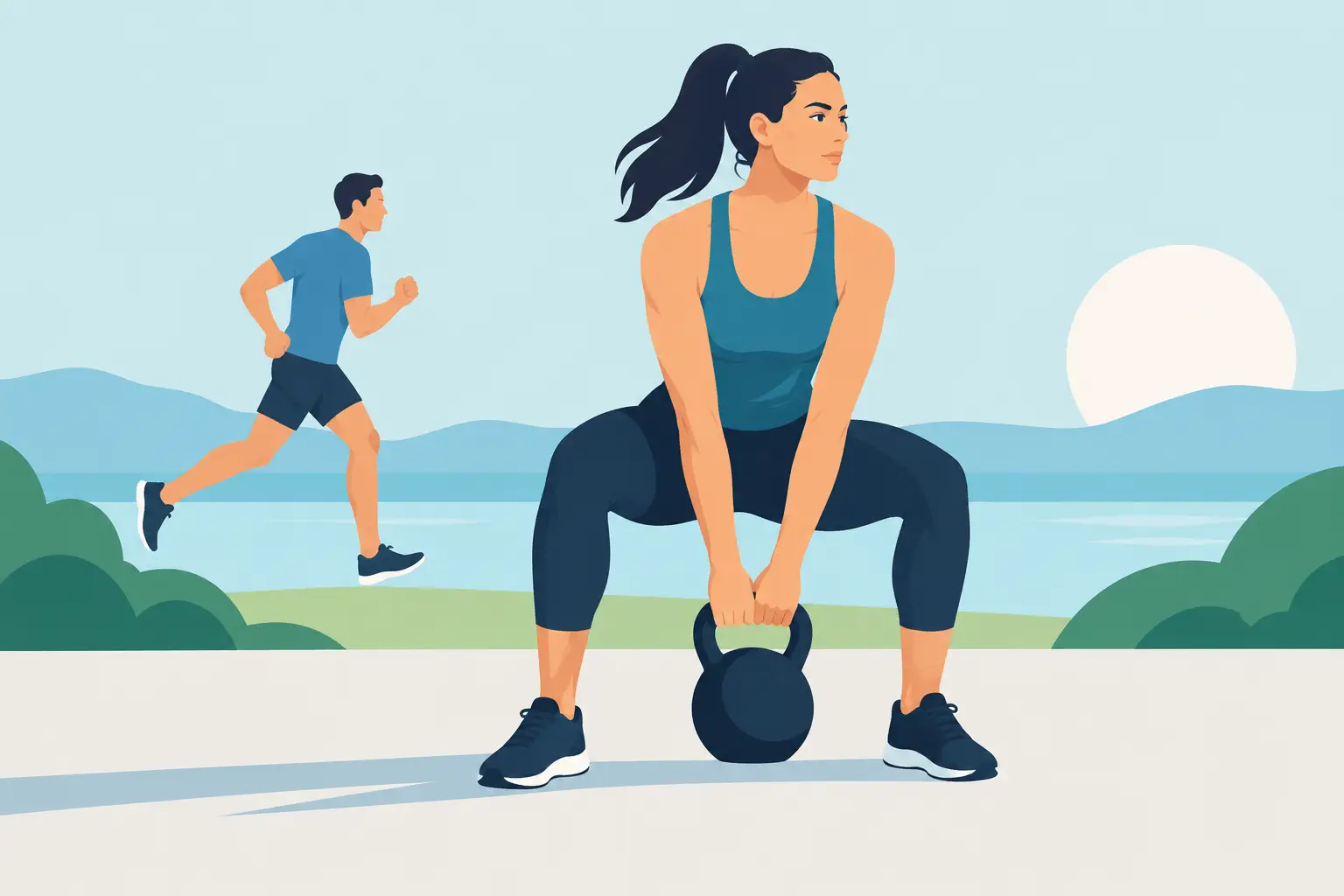
A runner does not need more random fatigue. They need strength that holds position when form starts to fade at mile 10, on the final hill, or during a fast finish. Runners kettlebell exercises can build that strength with a small equipment footprint and a clear purpose: stronger hips, better single-leg control, a more stable trunk, and force that transfers through the ground.
The goal is not to turn every runner into a kettlebell sport athlete. It is to use loaded movement intelligently, protect quality running sessions, and earn durable strength over time.
Why kettlebells work for runners
Running is repetitive single-leg work. Every stride demands hip extension, pelvic control, ankle stiffness, trunk stability, and coordination. Kettlebells train those qualities without requiring a complicated gym setup.
Their offset load is useful. A bell held in one hand pulls the body slightly off center, forcing the trunk and hips to resist rotation. That matters when fatigue tries to collapse your posture or let one hip drop with each stride. Ballistic movements such as swings also train fast hip extension, but they must be earned through sound hinge mechanics.
There is a trade-off. Hard strength sessions can create soreness and reduce the quality of interval work, long runs, or races. For runners, the best program is rarely the hardest possible program. It is the one that makes running more durable without stealing from the sessions that matter most.
The best runners kettlebell exercises
Start with controlled lifts. Build load only when positions stay clean. A heavier bell does not improve a movement that has already lost its shape.
Kettlebell deadlift
The deadlift is the hinge pattern stripped to its essentials. It teaches you to load the hips and hamstrings while keeping the spine organized. For runners who tend to squat every lift or bend through the lower back, this is the first correction.
Set the kettlebell on the floor between your feet. Push the hips back, keep your ribs stacked over your pelvis, grip the handle, and drive the floor away. Stand tall without leaning back. Lower the bell under control.
Use 3 to 4 sets of 5 to 8 repetitions. This is a good choice early in a strength plan or after a layoff because it builds posterior-chain strength without the speed and timing demands of a swing.
Two-hand kettlebell swing
A clean swing is a hip hinge performed with speed. The bell moves because the hips extend sharply, not because the arms lift it. For runners, it can develop powerful hip extension and conditioning with low impact.
Hike the bell back high between the thighs, as if passing a football. Keep the shins relatively vertical, snap the hips through, and let the bell float to roughly chest height. At the top, lock out the hips and knees, brace the trunk, and keep the shoulders packed. Then let the bell fall before hinging again.
Start with 6 to 10 crisp repetitions per set. Stop before the hinge turns into a squat, the back rounds, or the bell begins to pull you forward. Swings fit best after an easy run or on a separate strength day, not before track repeats or a long run.
Goblet squat
The goblet squat builds leg strength through a full, controlled range while giving the torso a clear counterbalance. It is valuable for climbing, descending, and maintaining leg stiffness late in a race.
Hold the bell close to the chest by the horns. Brace before descending, let the knees track in line with the toes, and keep the whole foot connected to the floor. Drive up with control. Do not chase depth if the pelvis tucks sharply under or the heels rise.
Perform 3 sets of 6 to 10 repetitions. If running volume is high, use a moderate load and leave 2 to 3 good repetitions in reserve. The objective is repeatable strength, not a leg day that ruins tomorrow's run.
Reverse lunge with a suitcase hold
This is one of the most useful single-leg runners kettlebell exercises because it combines unilateral leg work with anti-rotation. Holding the bell in one hand makes the trunk work to stay level while the front leg produces force.
Hold the kettlebell at your side, step backward, and lower under control. Keep the front knee tracking over the middle toes and avoid letting the loaded-side shoulder sink. Push through the front foot to return to standing. Complete all reps on one side, then switch the bell and the working leg.
Use 2 to 3 sets of 5 to 8 repetitions per side. Start light. A runner who can control this movement without shifting or wobbling is building the kind of hip stability that carries into every stride.
Single-leg Romanian deadlift
The single-leg Romanian deadlift targets the hamstrings and glutes while exposing gaps in balance and hip control. It is not a balance trick. The priority is loading the standing hip while keeping the pelvis square.
Hold one kettlebell in the hand opposite the working leg. Soften the standing knee, send the free leg behind you, and reach the bell toward the floor as the hips move back. Keep the hips level and return by driving the standing hip forward.
Two or three sets of 5 to 6 repetitions per side are enough. Use a wall or rack lightly for support if balance prevents you from loading the movement correctly. Strength comes from tension and position, not from making every set unstable.
Suitcase carry
Carries are simple, hard, and highly specific to the challenge of maintaining posture under fatigue. The suitcase carry trains grip, trunk stiffness, shoulder position, and gait control without asking for high-impact repetitions.
Pick up one bell, stand tall, and walk slowly. Keep the ribs down, shoulders level, and steps quiet. Do not lean away from the bell or rush to finish the distance.
Carry for 20 to 40 yards per side, for 2 to 4 rounds. It is an excellent low-soreness option during race preparation, when heavy squats or high-volume lunges may be harder to recover from.
Build a runner-friendly kettlebell session
Two sessions per week work well for most recreational and competitive runners. Place the more demanding session after an easy run or on a day well separated from your key workout. Keep the day before speed work, hill repeats, and long runs relatively fresh.
A practical session might pair deadlifts or swings with goblet squats, then finish with reverse lunges and suitcase carries. Rest enough to perform each set with intent. This is strength training, not a breathless circuit.
For a lower-volume race-season session, use swings, a few sets of reverse lunges, and carries. For an off-season block, increase strength work gradually with deadlifts, squats, and single-leg Romanian deadlifts. The right dose depends on your mileage, running history, sleep, and how close you are to a race.
Choose load based on control
Do not select a kettlebell based on ego or a generic internet prescription. Choose a load you can move with complete control for the prescribed sets. For deadlifts and squats, the bell should feel challenging while allowing a stable trunk and full-foot pressure. For swings, choose a weight you can snap with power without pulling through the arms.
Competition kettlebells use standardized dimensions across different weights, which can make progression feel consistent as load increases. Hardstyle cast-iron kettlebells are a durable choice for foundational strength work. Either can serve a runner well. The better option is the one that suits your training environment, grip preference, and progression plan.
Add reps first, then sets, then load. A small increase performed well beats a large jump that changes your mechanics. Do not start with a 32 kg bell because it looks serious. Serious training is measured by repeatable, technically sound work.
Keep the running goal in charge
Kettlebells should support your running, not compete with it. If your stride feels heavy for days after lifting, reduce the volume. If your hips and trunk feel stronger but your key sessions remain sharp, the dose is probably working.
Train the hinge. Train one leg at a time. Carry weight with purpose. Then go run and let the work show up where it counts: in a stride that stays strong when the easy miles are over.