
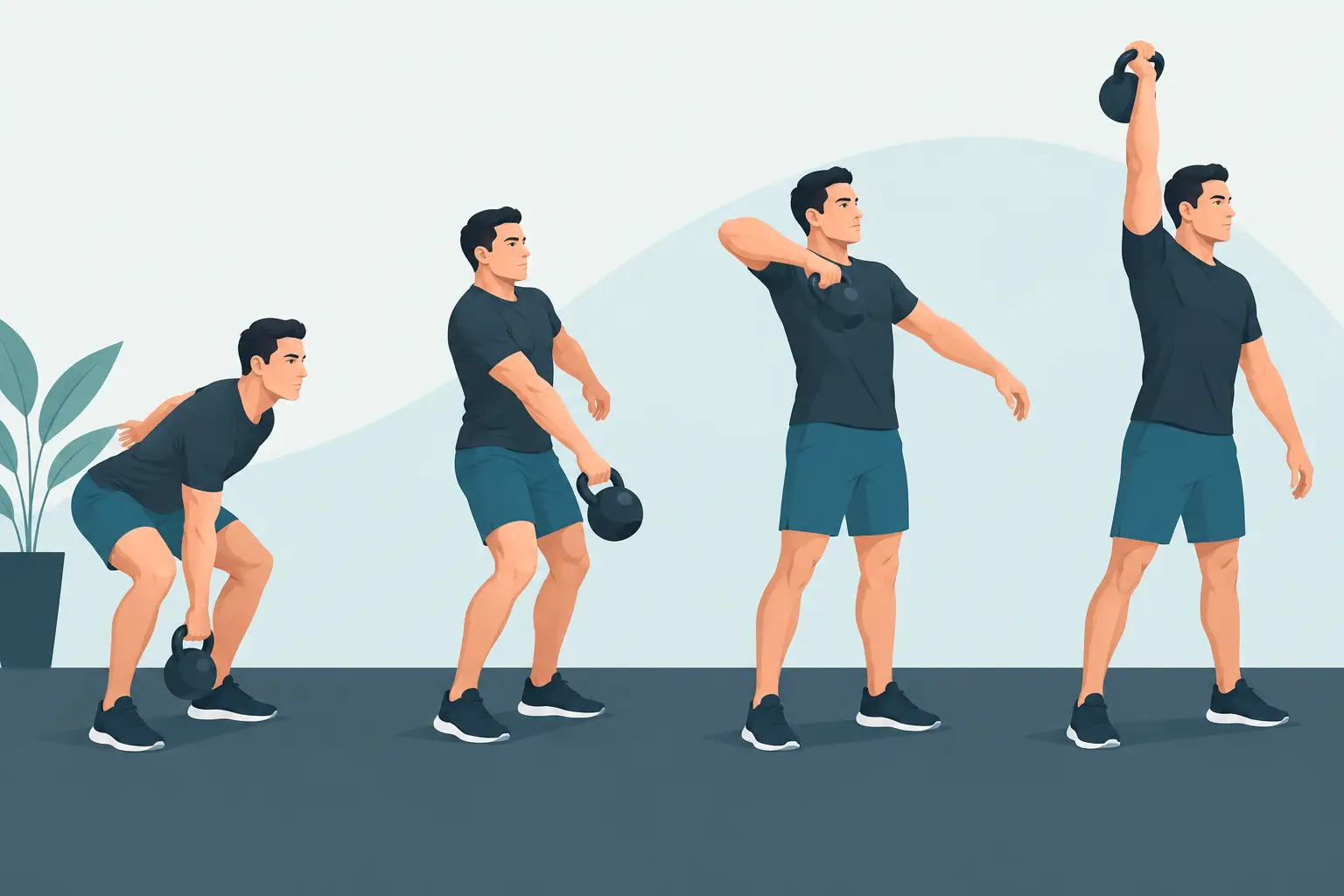
A kettlebell snatch should finish with a quiet lockout, not a forearm slap and a fight for balance. If every rep leaves your grip shredded, pulls you forward, or makes your shoulder feel unstable, the answer is rarely more effort. Learning how to improve kettlebell snatch performance starts with cleaner positions, better timing, and progression you can repeat.
The snatch is a ballistic lift. Power begins at the floor, travels through the hips, and finishes overhead in a stable, stacked position. The arm guides the bell. It does not haul it upward. Earn your reps by treating each phase as a skill.
Build the Snatch From a Strong Swing
A poor swing does not become a good snatch when the bell goes overhead. It becomes a poor snatch with more moving parts. Before increasing snatch volume, make sure your one-arm swing is sharp and consistent.
At the bottom, hinge rather than squat. Keep the bell close to the body, load the hamstrings, and maintain a packed shoulder without pulling the shoulder blade aggressively down. Then drive the floor away. Your hips create the force; the bell should float from that force instead of being lifted by the biceps.
A strong swing also gives you a predictable bell path. The bell should travel close to the midline on the way up and return close to the body on the way down. If it swings far forward, you will have to chase it overhead and absorb excessive pull through the shoulder.
Train one-arm swings until you can maintain the same hinge, breathing rhythm, and shoulder control on both sides. If your non-dominant side feels dramatically different, it needs more technical practice, not rushed loading.
Fix the Bell Path Before You Fix the Grip
Most painful snatches are blamed on the hand. Often, the real problem begins earlier. The bell is traveling in an arc too far from the body, then crashing over the hand at the top.
As the bell rises from the swing, keep it close. Think of directing it up through a narrow vertical lane rather than casting it outward. When the bell reaches roughly chest height, punch your hand through the handle. Do not wait for the bell to reach its highest point and then let it roll onto the forearm.
The hand insertion is active but not violent. Your fingers relax enough to let the handle rotate around the hand, then reconnect as the bell settles into the rack-side of the forearm. The goal is a quiet turnover. A loud slap usually means you are late, gripping too hard, or allowing the bell to drift away.
Do not try to solve a bad turnover by wearing thicker wrist protection. It may reduce discomfort, but it can hide the technical error that needs attention. Chalk, clean hands, and sensible volume help. They do not replace timing.
Use the High Pull as Your Diagnostic Drill
The kettlebell high pull is one of the most useful drills for improving the snatch because it exposes the bell path. Drive from the hips, then guide the bell toward the upper chest with the elbow traveling high and back. The bell should stay close, and the shoulder should remain controlled.
If the high pull loops forward or forces you to shrug hard, your snatch will likely do the same. Practice high pulls in low-rep sets until the trajectory is clean. Then add the hand insertion without changing the path.
Own the Overhead Lockout
The top of a snatch is not a rest position if you cannot organize it. Finish every rep with the bell over the shoulder, shoulder over the hip, and hip over the foot. Your wrist stays neutral, elbow locked, and ribs controlled.
Avoid leaning back to create room for the bell. That compensation turns an overhead stability issue into a lower-back problem. Instead, squeeze the glute on the working side, brace the trunk, and reach tall through the locked arm without losing rib position.
Shoulder mobility matters, but mobility alone is not enough. You also need active control. A lifter may be able to place an arm overhead without load yet struggle to stabilize a kettlebell after a fast ballistic pull. Bottoms-up carries, overhead carries, and controlled Turkish get-up segments can build the stability that the snatch demands.
If lockout is unstable, reduce the bell weight and slow the training down. A heavier bell can sometimes make the turnover feel smoother because it provides more feedback, but only if you can maintain a safe overhead position. Load should clarify technique, not force compensation.
Improve the Kettlebell Snatch With Smart Progressions
The fastest way to stall is to test high-rep snatches before your technique is ready. Fatigue magnifies every leak: the swing gets shallow, the bell moves away, the grip tightens, and the lockout becomes soft. Build capacity in layers.
Start with crisp sets of three to five reps per arm. Rest long enough to preserve speed and position. When those reps are repeatable, add total sets before you add larger unbroken sets. This approach gives you more quality turnover practice without turning each session into a grip survival test.
A practical progression can move from swings and high pulls to dead-stop snatches, then to repeated snatches. Dead-stop reps remove momentum between repetitions and demand a disciplined setup. Repeated reps develop rhythm and conditioning, but they should come after you can own the first rep.
For many beginners and intermediate lifters, two snatch sessions per week is enough. One day can emphasize technique with lower volume and deliberate drills. The other can emphasize density or conditioning with controlled sets. Exact volume depends on your training age, current grip tolerance, other pulling work, and the weight of the bell.
Choose Equipment That Supports Consistency
Kettlebell shape changes how the snatch feels. Competition kettlebells use standardized dimensions across weights, so the handle position and bell body remain familiar as you progress. That consistency is valuable when you are refining the turnover and planning long-term volume.
Hardstyle cast-iron kettlebells can also be excellent training tools, especially for powerful swings, strength-focused snatches, and home training. Their dimensions may change more noticeably from weight to weight, so give yourself time to adjust when moving up. Neither style is automatically better. Choose based on your training goal, available space, preferred feel, and whether standardized handling matters to your program.
Handle condition matters more than cosmetic details. A smooth but not slippery handle, a clean casting surface, and enough room for your hand reduce unnecessary friction. Avoid starting with an oversized bell simply because it is the next number available. A 32 kg kettlebell is not a first snatch bell. Build the pattern first.
Common Errors That Hold Back Progress
Watch for these patterns during training:
- Pulling early with the arm, which disconnects the snatch from hip power.
- Casting the bell forward, which creates a hard forearm impact and an unstable lockout.
- Death-gripping the handle, which burns the forearm and delays the turnover.
- Bending backward overhead, which trades shoulder control for lumbar extension.
- Training high-rep sets while technique is already breaking down.
Film a few sets from the side and front. You are looking for a close bell path, a full hip extension, a quiet turnover, and a stacked finish. Video is useful because the errors that feel small during fast reps are often obvious on playback.
Train the Descent With Equal Discipline
The drop from overhead is not passive. From lockout, let the bell fall slightly forward as you guide it around the hand, then reconnect to the handle as it returns. Keep the bell close to the body and absorb it through the hinge.
Do not let the bell pull the shoulder forward or yank you into the bottom position. A controlled descent protects the shoulder, saves grip, and sets up the next powerful swing. For repeated snatches, the descent often determines whether the next rep is strong or ugly.
Practice single reps with a deliberate reset when you are learning. Then use short repeated sets to build rhythm. The transition should become efficient, not careless.
A better snatch is not earned by forcing more reps through a flawed pattern. Build power from the hinge, keep the bell close, punch through early, and own every lockout. Stay patient with the load. Clean reps accumulate, and eventually the movement feels less like catching a falling object and more like directing power with precision.