
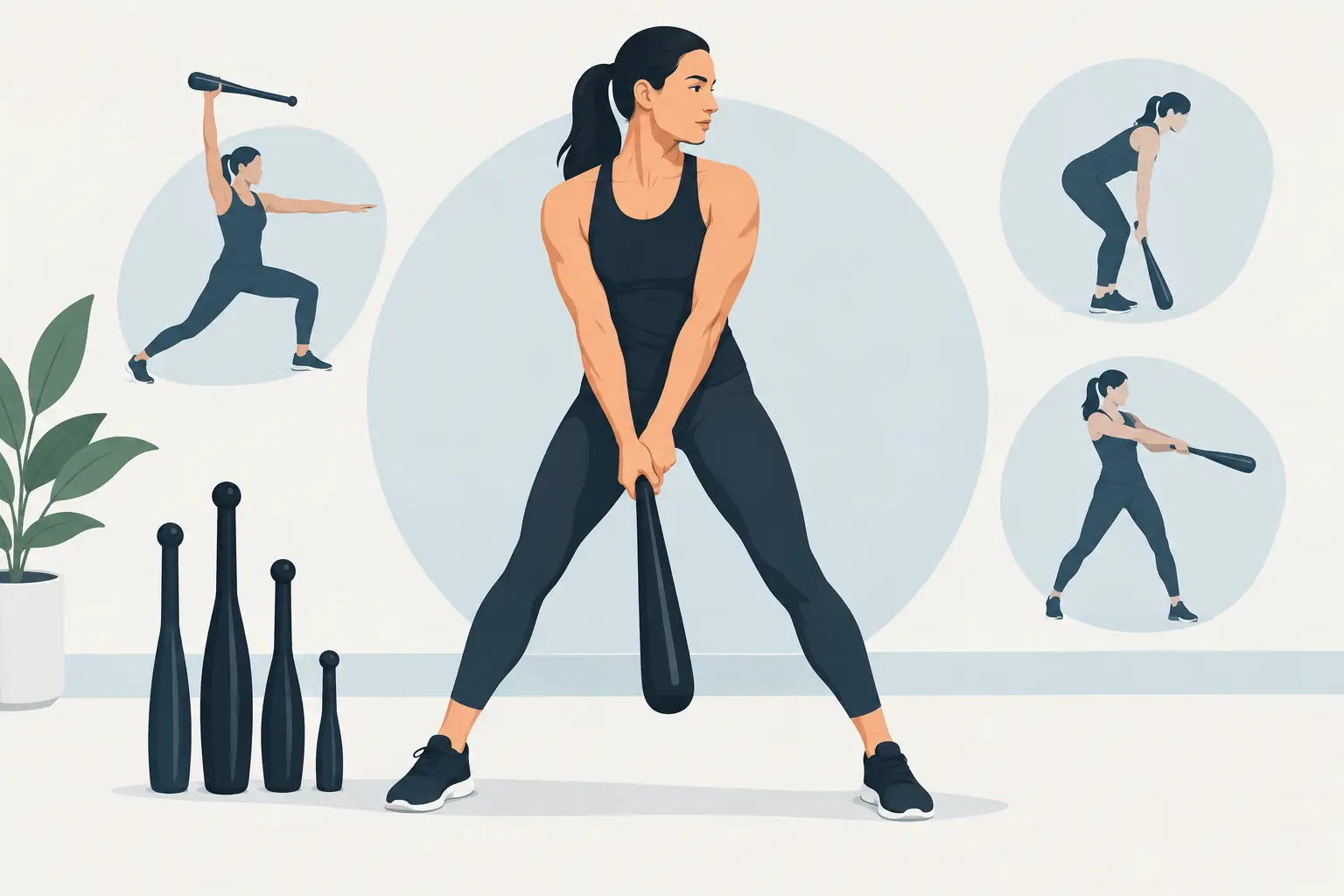
Clubbells punish vague training. The offset load creates leverage that exposes weak grip, poor shoulder control, and a soft trunk fast. A useful guide to clubbell programming starts with that reality: do not collect movements. Build a plan around positions you can own, loads you can control, and progress you can measure.
Clubbell work can develop mobility and strength in the same session, but it is not automatically joint-friendly. Fast circles with poor mechanics are still poor mechanics. Earn clean reps first. Then add volume, load, complexity, or speed.
What Clubbell Training Should Do
A clubbell is not just a lighter substitute for a barbell or kettlebell. Its long lever shifts more demand toward the hands, forearms, shoulders, trunk, and rotational chain. That makes it useful for athletes who need rotational power, lifters building resilient shoulders, and general trainees who want strength that carries into real movement.
Your program should have a primary job. For most people, that job is one of three things: mobility under load, strength endurance, or rotational conditioning. You can train all three over time, but trying to push every quality hard in every session produces sloppy work and stalled progress.
If your shoulders are stiff or you are new to clubs, begin with control and range of motion. If you already own the basic patterns, use heavier clubs and lower rep ranges for strength. If conditioning is the goal, keep the load modest enough that each rep stays organized when breathing gets hard.
Guide to Clubbell Programming: Start With Movement Families
Program movement families, not a random catalog of drills. The clubbell has several core patterns that cover most useful training.
Front pendulums and shield casts teach bracing, grip connection, and the path of the club around the body. Mills and reverse mills develop shoulder coordination and controlled rotation. Swipes train a powerful hinge with an arc that demands timing through the trunk and lats. Clean-to-press variations add vertical strength, while lateral or circular patterns challenge frontal-plane control.
For a beginner, two or three patterns in one session are enough. A pendulum, a mill regression, and a supported press create more progress than a dozen movements performed once each. Experienced trainees can combine a hinge-focused movement such as swipes with mills and presses, provided the shoulder work does not degrade.
Keep both directions in the plan. Clockwise and counterclockwise work reveal asymmetries that straight-line lifting can hide. Do not assume your non-dominant side needs the same volume forever, though. Match the work initially, then let quality determine whether a small amount of extra practice is useful.
Choose Load by the Hardest Position
The right clubbell weight is determined by your weakest point in the movement, not by how easily you can start the rep. In a mill, that point may be the transition behind the shoulder. In a swipe, it may be the moment you must brake the club and reconnect the lats before the next hinge.
A load is appropriate when you can keep a stable wrist, quiet ribs, and controlled shoulder path for every planned rep. If you are bending the wrist back, leaning away from the club, or forcing the elbow into a bad position, the load is too heavy or the variation is too advanced.
For technical practice, choose a club you could use for several more clean reps than the set requires. For strength work, use a heavier tool but keep the set short enough to avoid compensating. There is no prize for swinging a club that owns you.
Clubbell jumps can feel large because leverage magnifies small increases in load. This is why a lighter club is not a beginner-only purchase. It remains a technical tool, a warm-up tool, and a high-quality conditioning tool as your strength improves.
Build Sessions Around a Clear Priority
A clubbell session works best when the most demanding skill appears early, before fatigue blurs positions. Start with a brief general warm-up, then use unloaded or light club circles, pendulums, and controlled hangs to assess the shoulders and wrists.
After that, organize the work in three parts: skill or strength, supporting volume, and optional conditioning. The exact exercise selection depends on your goal, but the structure stays reliable.
For mobility and skill, use controlled sets of 3 to 6 reps per side. Rest enough to reset your grip and posture. Five sets of crisp mills are more valuable than one long set that turns into a shoulder scramble.
For strength, work in sets of 4 to 8 reps per side with a heavier clubbell. Pair a club press or clean-to-press with swipes, rows, pull-ups, or loaded carries. Club training is powerful, but it does not replace every form of progressive resistance. A balanced plan still needs lower-body strength, pulling, pressing, and locomotion.
For conditioning, use repeatable intervals rather than chasing chaos. For example, perform 20 seconds of pendulums or light swipes, rest 40 seconds, and repeat for 8 to 12 rounds. When every round looks the same, reduce rest or add rounds. Do not increase load, speed, and density at once.
A Practical Three-Day Weekly Framework
Three sessions per week give most trainees enough exposure to improve without beating up the hands and shoulders. Space them across the week when possible.
Day one is a technique and mobility session. Use pendulums, shield casts, and a mill regression for 4 to 6 sets of low-rep practice. Finish with easy carries or a short walk holding the club in a stable position. This day should leave your shoulders feeling better, not battered.
Day two is strength focused. Start with clubbell swipes for 5 sets of 5 reps, then use a clean-to-press variation for 4 sets of 4 to 6 reps per side. Add a pull movement and a squat or split squat. Rest fully between hard sets. Strength is built when force stays organized.
Day three is conditioning and flow, but flow is earned. Select two movements you can perform without hesitation, such as pendulums and front swipes. Alternate them in timed blocks for 12 to 20 minutes. Keep the club light enough to maintain the same hinge depth, breathing rhythm, and shoulder position from the first interval to the last.
If you already lift heavy with barbells, kettlebells, or sport-specific training, two clubbell sessions may be the better choice. Use one session for mobility and skill, the other for strength or conditioning. More work is not always better. Better recovery protects better training.
Progress One Variable at a Time
Clubbell programming becomes measurable when you stop changing everything at once. Progress can mean more clean reps, more sets, less rest, a heavier club, a longer range of motion, or a more demanding variation. Choose one.
A simple four-week block works well. In week one, establish clean baseline volume. In week two, add one or two reps to selected sets. In week three, add a set or reduce rest slightly. In week four, keep the same load but cut volume by roughly one-third, or return to technical practice. Then assess whether load should increase.
Record the club weight, direction, reps, rest periods, and any discomfort. Shoulder fatigue is normal after unfamiliar work. Sharp pain, numbness, pinching, or worsening symptoms are not training signals to ignore. Regress the movement, shorten the range, or seek qualified coaching when needed.
Common Errors That Stall Progress
The first error is treating every clubbell drill as a speed drill. Speed comes after path, grip, and posture. The second is gripping too hard from the first rep. Maintain control, but let the hand adjust as the club moves. A death grip often creates unnecessary tension through the forearm and shoulder.
Another common mistake is using rotation without a stable base. Your hips and ribs must work together. If the pelvis spins freely while the ribs flare, the club may move, but the trunk is not transferring force well. Build the ability to brace, hinge, and rotate in sequence.
Finally, do not confuse soreness with progress. A clubbell can create a strong training effect with modest loading. Quality volume, consistent practice, and equipment built to last will take you further than occasional all-out sessions.
Use the clubbell to make your shoulders more capable, your grip more dependable, and your rotation more powerful. Keep the plan simple enough to repeat. Then earn your reps.