
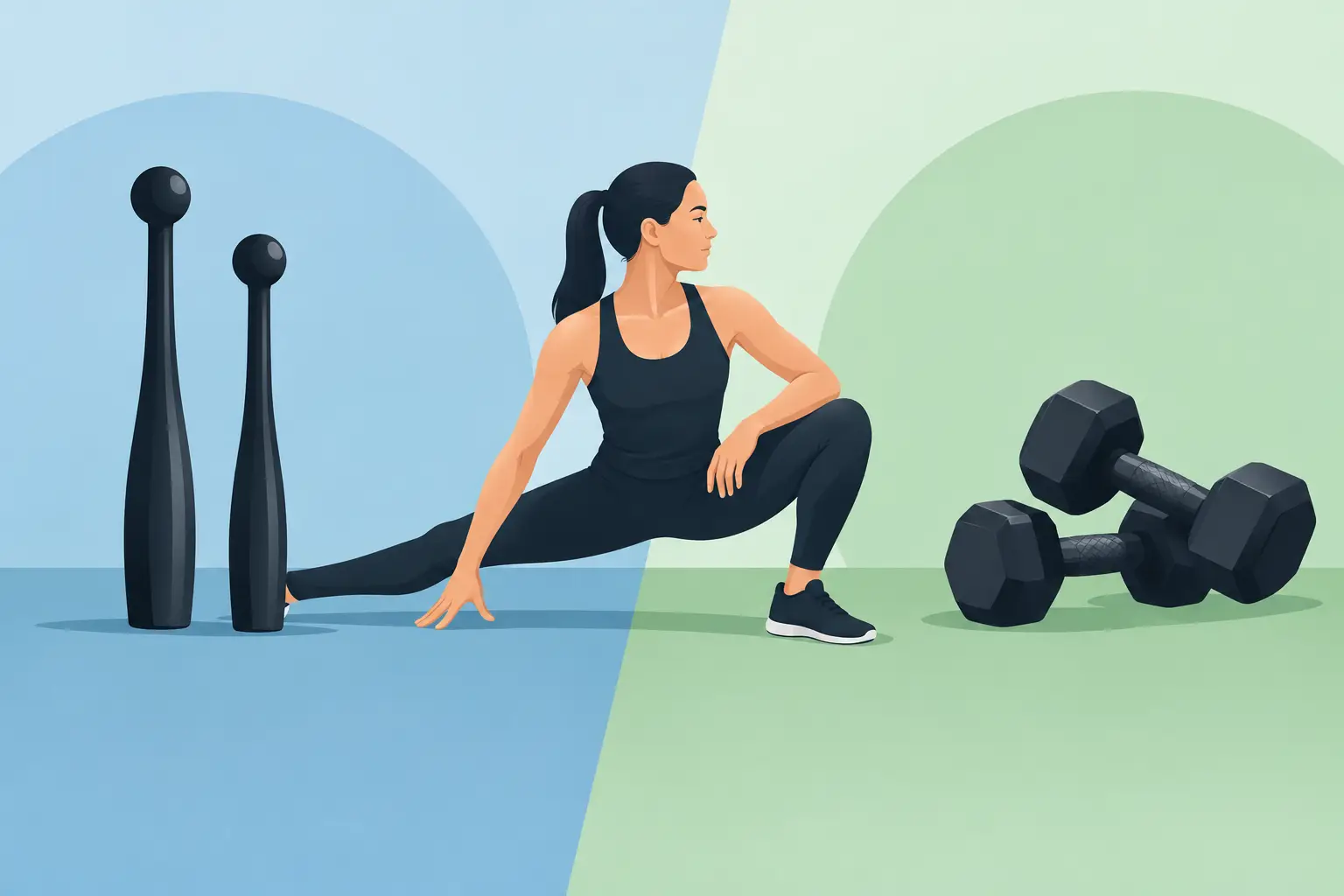
A shoulder that can press a dumbbell overhead is not always a shoulder that can control a clubbell circle. Both tools can build useful strength, but they challenge mobility through very different loading patterns. When comparing clubbells versus dumbbells for mobility, the real question is not which tool is better overall. It is which tool asks your body to move, stabilize, and adapt in the way your training currently needs.
Dumbbells are familiar, efficient, and easy to load progressively. Clubbells place much of their mass away from the hand, creating leverage that demands stronger grip, more active shoulder control, and better coordination through circular patterns. Used well, both belong in a serious training plan. Used carelessly, either can turn a mobility session into a compensation drill.
Clubbells Versus Dumbbells for Mobility: The Main Difference
A dumbbell keeps most of its mass close to the hand. This makes it stable and predictable. During a press, row, curl, or carry, the body manages the weight largely through straight-line force. You can adjust the load in small jumps, train each side independently, and build strength through a broad range of conventional movement patterns.
A clubbell is different because its center of mass sits farther from the grip. A relatively light club can create substantial torque at the wrist, elbow, and shoulder. That longer lever is the reason clubbells are effective for mobility and strength work. It is also the reason a clubbell weight that looks modest on paper can feel demanding in motion.
Mobility is not passive flexibility. It is the ability to control a joint through its available range under the demands of a task. Clubbells load that control through arcs, circles, casts, and transitions. Dumbbells load it through more direct patterns, including presses at varied angles, controlled raises, carries, and end-range isometrics.
Neither implement magically fixes restricted movement. If you lack shoulder flexion, thoracic extension, or wrist tolerance, adding load will not solve the issue by itself. The tool must match the range you can currently own.
Where Dumbbells Win
Dumbbells are usually the better starting point when you need simple loading, clear progression, and stable positions. They let you train mobility-strength without introducing a large leverage demand too early.
For example, a half-kneeling single-arm dumbbell press can expose limitations in hip position, trunk control, and shoulder flexion while still keeping the movement easy to understand. A dumbbell lateral raise performed slowly can strengthen the shoulder through a controlled arc. A suitcase carry can build grip, trunk stability, and gait control without requiring advanced coordination.
Dumbbells also make it easier to work near a specific weak point. If one shoulder is less stable overhead, you can use light presses, bottoms-up holds with an appropriately shaped tool, or supported rows to build capacity without forcing a complex rotational pattern. This matters for beginners, athletes returning after a layoff, and lifters whose training already includes heavy barbell work.
Their limitation is that dumbbells do not naturally encourage continuous circular movement. You can create diagonal and rotational drills with them, but their balanced shape does not challenge deceleration and direction changes in the same way. For general strength with a mobility benefit, that may be enough. For dedicated shoulder and rotational conditioning, it may not be.
Where Clubbells Earn Their Place
Clubbells excel when the goal is to develop stronger, more resilient movement through the shoulders, elbows, wrists, and upper back. Their offset load gives the body a reason to stabilize throughout a path, not just at the beginning and end of a rep.
The classic examples are shield casts, mills, and pendulum-style patterns. These movements require the shoulders to rotate while the scapulae move and the torso remains organized. Done with control, they train grip endurance, joint awareness, and rotational strength together. The club does not just test whether you can reach a position. It tests whether you can guide load into and out of it.
This is particularly valuable for people whose work or sport involves force outside a neat straight line. Grapplers, field athletes, climbers, throwers, and functional fitness athletes often benefit from learning to control rotation rather than only producing it. Lifters who spend most of their time pressing, pulling, and squatting can also use clubbells to add movement variety without abandoning strength work.
The trade-off is skill. A clubbell can expose poor mechanics quickly. If your ribs flare during an overhead path, your wrist collapses during a cast, or you rush to make the circle look smooth, the drill stops being mobility work. It becomes a rehearsal of weak positions.
Load Changes Everything
With dumbbells, many trainees think in terms of muscular fatigue: can I complete eight to twelve clean repetitions? With clubbells, the first question should be positional control: can I guide the implement through the entire path without gripping desperately, bending the wrist, or losing shoulder position?
Start lighter than your ego suggests. This is especially true if you are new to offset loading. A heavy dumbbell may be manageable in a row, while a much lighter clubbell can challenge the same arm intensely during a controlled circular drill.
For mobility-focused clubbell work, smooth repetitions matter more than a large number on the side of the tool. Use a load that allows slow transitions, a stable torso, and an even rhythm on both sides. If you must shorten the range or swing the clubbell to recover, reduce the weight or simplify the pattern.
Dumbbells offer more freedom to increase resistance aggressively, especially in presses, rows, and carries. Clubbells reward more patient progression. Add range first, then quality repetitions, then volume, and finally load. Earn your reps before you earn heavier steel.
Choosing the Right Tool for Your Goal
Choose dumbbells if your main need is foundational strength with controlled access to range. They are the practical choice for building pressing capacity, unilateral stability, and carries. They also fit easily into nearly every home gym or commercial gym program.
Choose clubbells if you already have basic shoulder control and want to train mobility as an active, loaded skill. They are especially useful if your program lacks rotation, circular movement, grip endurance, or overhead coordination. A steel clubbell is not a replacement for every dumbbell exercise. It fills a gap that dumbbells do not address as directly.
For most trainees, the strongest answer is not clubbells or dumbbells. It is a sequence. Use dumbbells to establish the strength and positional confidence needed for good movement. Use clubbells to challenge that movement through longer levers and more demanding paths.
A simple week might include dumbbell presses and rows on strength days, then light clubbell casts or shield patterns during a separate mobility-strength session. Keep the clubbell work crisp rather than exhausting. Two or three technically sound sets can deliver more value than a high-rep grind performed with deteriorating positions.
Technique Rules That Protect the Benefit
The shoulder should not do all the work alone. In both dumbbell and clubbell training, the rib cage, upper back, scapulae, grip, and hips contribute to a stable movement base. If one area stops contributing, another often compensates.
Keep the ribs stacked over the pelvis when possible. Avoid turning every overhead repetition into a lower-back extension. Maintain a firm but not frantic grip. Let the shoulder blade move naturally rather than pinning it down throughout every pattern. During clubbell drills, slow down the return phase. Deceleration is where much of the training value lives.
Pain is not a mobility signal to push through. Muscular effort, mild stretching, and fatigue are expected. Sharp pain, catching, numbness, or persistent joint irritation are not. Regress the range, load, or exercise selection before adding more work.
Build Mobility You Can Use
Dumbbells provide the stable foundation. Clubbells add the leverage, rotation, and active control that many programs leave untouched. The better choice depends on whether you need simpler strength work, more demanding movement practice, or both.
Start with the positions you can control today, keep the load honest, and let quality determine progression. Mobility that holds up under load is built one disciplined repetition at a time.