
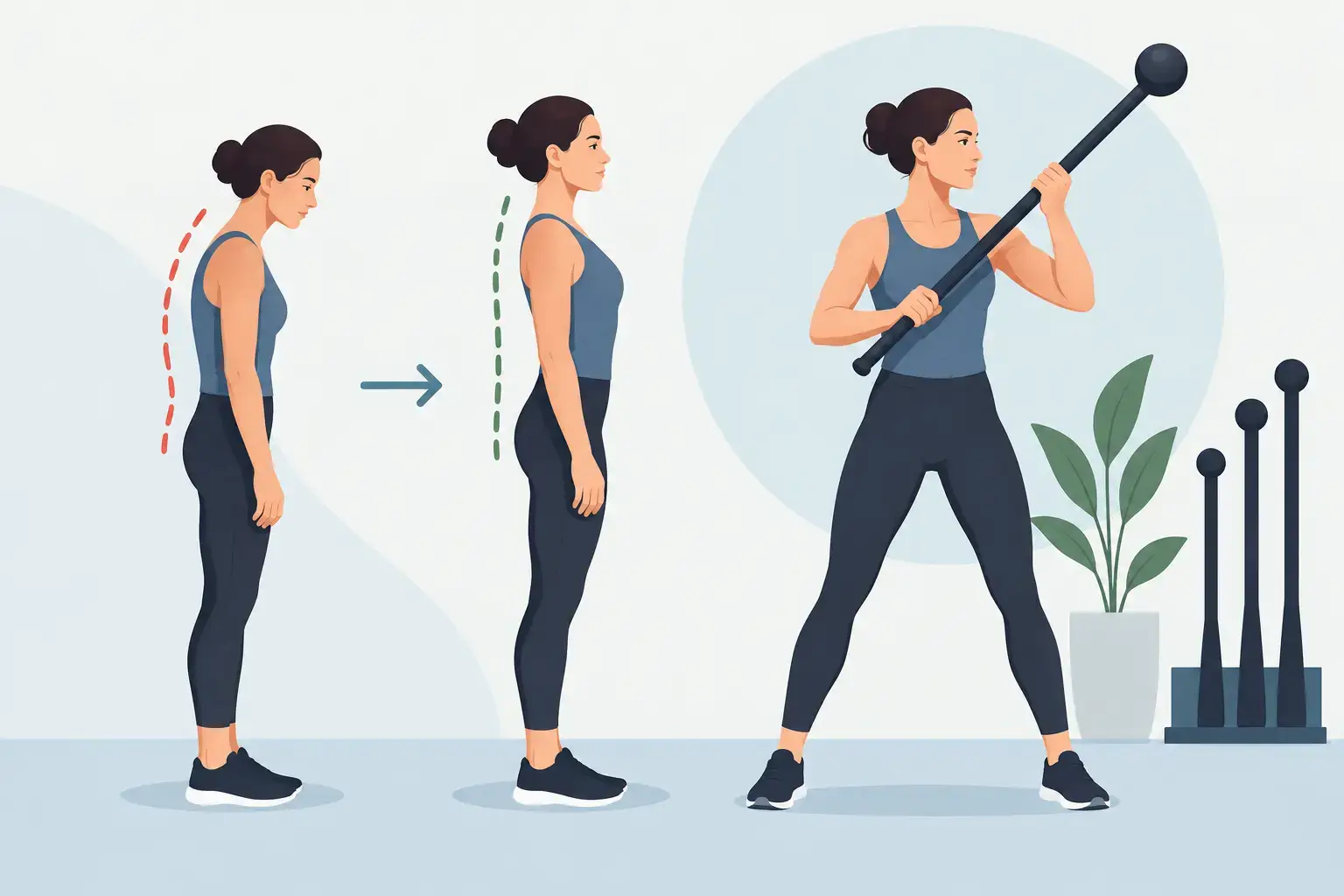
A desk-bound upper back does not need more random stretching. It needs strength, control, and a better relationship between the ribs, pelvis, shoulders, and head. Can mace training improve posture? Yes, when it is used as progressive strength work rather than a collection of flashy swings.
A steel mace puts most of its load away from your hands. That long lever exposes weak links in shoulder control, grip, trunk stiffness, and rotational coordination. Done well, mace work can help you build the capacity to hold stronger positions under load. Done poorly, it can turn into neck tension and sloppy compensation.
What Better Posture Actually Means
Posture is not one rigid position that you hold all day. A perfectly upright pose can be just as fatiguing as a slouch if you are forcing it. Useful posture is the ability to move freely, find a stacked position when needed, and resist unwanted movement when force is applied.
For strength training, that usually means you can keep your rib cage from flaring, avoid excessive low-back arching, control your shoulder blades on the rib cage, and keep your head from drifting forward during loaded work. It also means you can rotate through the upper back and hips without stealing motion from the lower back.
Mace training supports these qualities because the tool is deliberately awkward. The offset load creates torque. Your body has to organize itself to manage it. That demand can make a light mace more challenging than a heavier, evenly balanced dumbbell.
How Mace Training Can Improve Posture
The answer to whether mace training can improve posture comes down to three physical adaptations: shoulder control, trunk strength, and rotational awareness.
The Offset Load Trains Shoulder Control
When you hold a mace by the handle, the weighted head pulls away from your center. Your forearms, rotator cuff, upper back, and shoulder-blade stabilizers must work together to keep the mace on its intended path.
This matters for people who spend hours with their arms in front of them. A rounded upper-back position is not automatically bad, but living in one position can leave overhead motion and scapular control undertrained. Mace drills such as the 360, 10-to-2, and controlled presses ask the shoulders to move through a larger range while staying connected to the trunk.
The goal is not to pin your shoulder blades down and back. They need to glide, rotate, and stabilize. A mace can teach that distinction when the load is appropriate.
The Lever Demands a Stronger Trunk
Posture often breaks down under fatigue because the trunk loses position. The chest lifts, ribs flare, pelvis tips forward, and the neck takes over. A mace makes these leaks obvious.
In an offset front hold or a press, the load tries to pull you sideways, backward, or into rotation. Your obliques, deep trunk musculature, lats, and hips have to create enough tension to prevent unwanted motion. This is not about making your spine rigid all the time. It is about having options when force hits the body.
That is why basic mace holds can be as useful as advanced flow work. If you cannot stand tall with a light offset load while breathing steadily, more speed will not fix the problem.
Rotation Builds Awareness, Not Just Power
Mace training is often associated with rotational power. That is accurate, but posture benefits usually begin with rotational control. The 360 pattern requires the upper back, shoulders, and hips to share the work while the lumbar spine stays relatively stable.
Many trainees either avoid rotation completely or rotate only through the lower back. Neither approach is ideal. Controlled mace practice helps you feel whether your ribs are moving, whether your pelvis is shifting, and whether one shoulder is doing all the work. That feedback is valuable for athletes, lifters, and anyone trying to move better outside the gym.
The Mace Drills That Carry Over Best
You do not need a long routine. Start with a few drills that make clean position non-negotiable. Use a load you can control without gripping desperately, shrugging your shoulders, or leaning away from the mace head.
Offset Front Holds
Hold the mace vertically in front of the body with the head above your hands. Keep your ribs stacked over your pelvis and your chin level. The mace will challenge the shoulders and trunk without the complexity of a swing.
Perform short holds of 15 to 30 seconds per side. Breathe through the hold. If you cannot breathe quietly, reduce the load or shorten the lever by moving your top hand closer to the mace head.
Mace Presses
A strict mace press reveals whether you can keep the trunk organized while the shoulder moves overhead. Start from a stable stance and press with control. Avoid turning every repetition into a backbend.
Think of reaching the mace upward while keeping the lower ribs from popping forward. At the top, the shoulder should feel active and supported, not jammed into the ear. A slight natural upward shrug is normal in overhead work. Forced depression is not the target.
360s and 10-to-2s
These are classic mace patterns, but they are earned. Begin with slow, segmented repetitions. Learn the hand transition, keep your elbows close enough to control the path, and let the upper back and shoulders move without collapsing the rib cage.
A 360 can build mobility and strength through the shoulders and upper back, but only when it remains smooth. If the mace crashes behind the neck, your head juts forward, or your low back arches hard, the drill is currently too advanced or too heavy.
Offset Carries
Carry the mace in a front-rack, suitcase-style, or vertical position. Walking adds a practical challenge: you must resist sway and rotation while maintaining a calm, stacked posture.
Carries are especially useful for trainees who want posture benefits without technical mace flow. They are simple, measurable, and easy to progress through distance, time, or load.
What Mace Training Will Not Fix
A mace is not a cure for pain, scoliosis, structural changes, or the effects of ten hours of sitting. If you have persistent neck, shoulder, or back pain, get assessed by a qualified healthcare professional. Training should support your plan, not replace it.
It also will not improve posture if the rest of your program is poorly balanced. Heavy pressing without enough pulling, poor sleep, rushed technique, and no general movement throughout the day can all limit results. Mace work is a tool, not a correction ritual.
There is also a trade-off. The same long lever that makes a mace effective makes poor loading choices costly. Starting too heavy can reinforce the exact patterns you are trying to improve: shrugged shoulders, locked breathing, rib flare, and excessive low-back motion. Leave your ego out of the first sessions.
A Simple Mace Posture Session
Train this two or three times per week after a warm-up or as a short standalone session. Keep every rep controlled.
- Offset front hold: 3 sets of 20 seconds per side
- Half-kneeling mace press: 3 sets of 5 to 8 reps per side
- Slow 10-to-2: 3 sets of 4 to 6 reps per side
- Offset carry: 3 walks of 20 to 40 yards per side
Rest long enough to restore clean breathing and grip. Progress one variable at a time. Add a few seconds to holds, a few yards to carries, or one repetition to a set before increasing the mace weight.
For beginners, a lighter mace is usually the smarter choice. The load feels different because the mass sits at the end of a long handle. Technique, not toughness, determines the starting point. Incore Sports macebells are built for repeated rotational-strength work, but durable equipment still requires disciplined progression.
The Standard to Train Toward
Use the mace to build a posture that holds up when you walk, lift, carry, throw, and reach. Stand tall without forcing it. Keep the ribs and pelvis connected. Let the shoulders move with control. Build strength through ranges you can own.
Better posture is not something you pose for. It is something you earn rep by rep.