
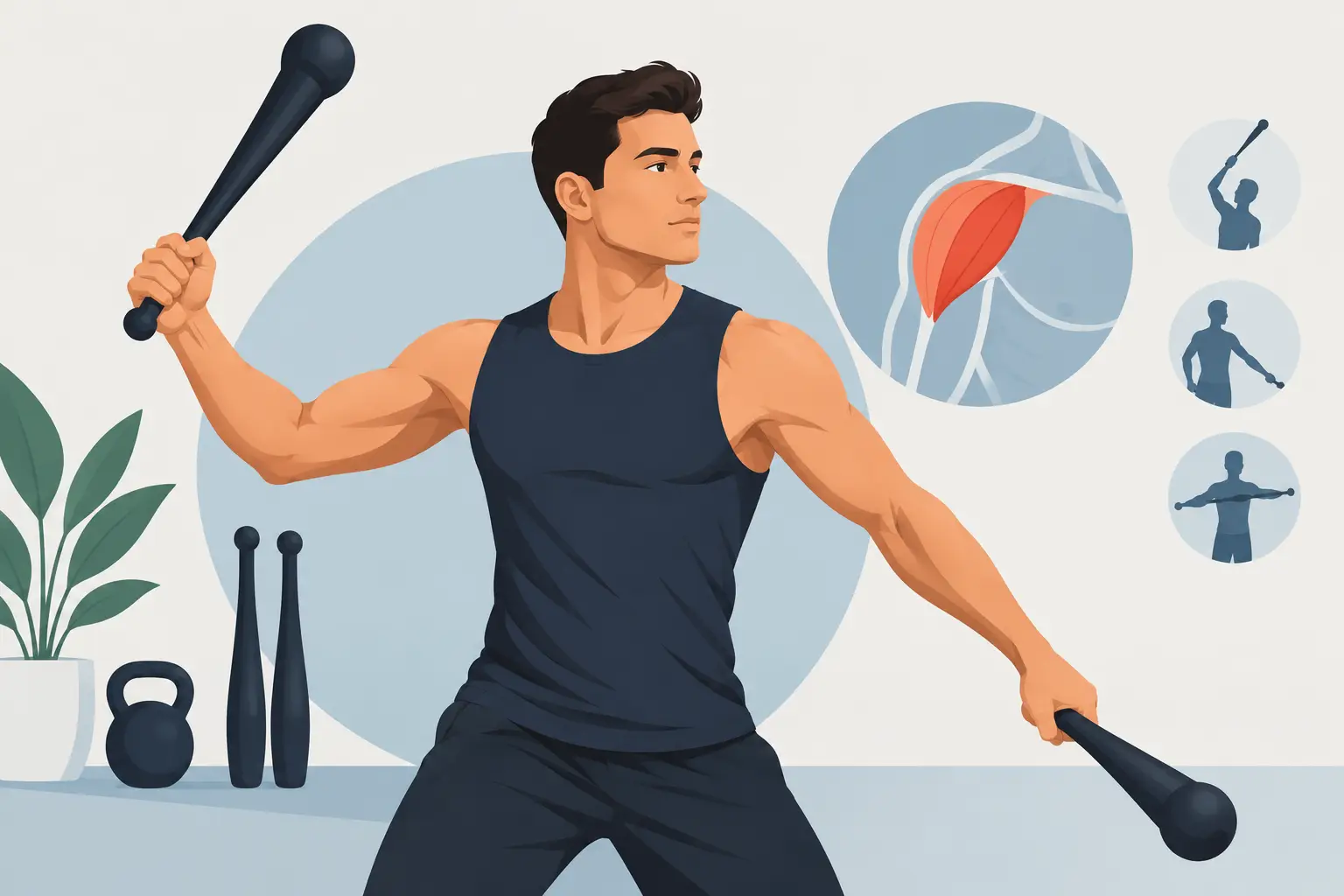
A shoulder that only presses is strong in one narrow lane. It may handle a barbell overhead, then feel unstable when you reach, rotate, catch, carry, or control a load outside that straight line. Can clubbells strengthen shoulders? Yes. Their long, offset shape makes the shoulder work through rotation, stabilization, and controlled leverage that conventional dumbbells do not emphasize in the same way.
Clubbells are not a replacement for pressing, rowing, or sound technique. They are a useful tool for building shoulders that can produce force and control it. That distinction matters. Shoulder training is not just about adding load to a press. It is about owning the joint through the positions your sport, work, and training demand.
Why clubbells challenge the shoulders differently
A clubbell carries most of its mass away from your hand. That creates leverage. Even a relatively light club can produce a demanding pull on the wrist, elbow, and shoulder as it travels around the body.
During a controlled swing, cast, or mill, the shoulder must guide the clubbell through changing angles while the rotator cuff and surrounding musculature keep the humeral head centered. The upper back, serratus anterior, forearm, and grip also contribute. This is not isolation work. It is coordinated strength.
The payoff is most noticeable when training includes slow, deliberate control. A clubbell moved carelessly becomes momentum training. A clubbell moved with position and tension becomes a shoulder-strength tool.
Can clubbells strengthen shoulders for pressing?
They can support stronger pressing, but they do not replace progressive overhead presses. If your goal is a bigger strict press, you still need to press. Barbell, kettlebell, dumbbell, or bodyweight variations provide the direct, measurable overload needed to drive that lift upward.
Clubbells strengthen the supporting qualities that can make pressing more stable: grip integrity, scapular control, rotational strength, and confidence in the overhead range. They can also expose weak links. If you lose rib position, shrug excessively, or let the club pull your elbow out of line, the load is too heavy or the pattern is not ready.
For athletes and experienced lifters, clubbells are especially valuable as accessory work. Use them after primary strength work or on a separate mobility and conditioning day. For beginners, they can build body awareness before heavy overhead loading, provided the starting weight is conservative.
The shoulder benefits that matter
Clubbell training can develop several qualities at once, but each depends on exercise choice and execution.
Rotational control
The shoulder is designed to rotate, not simply push and pull. Mills and shield casts train the arm to guide a lever through a circular path while resisting unwanted movement at the shoulder and torso. This can improve control in the ranges where many lifters feel stiff or disconnected.
Do not confuse rotation with forcing range. The goal is a smooth, pain-free path. If the shoulder pinches, catches, or feels unstable, shorten the range, reduce the load, or choose a simpler drill.
Scapular stability
Strong shoulders need shoulder blades that can move well and stay connected to the rib cage. Clubbell patterns demand active control of the scapula as the load changes direction. That is useful for overhead athletes, combat athletes, functional fitness trainees, and anyone who wants more resilient upper-body mechanics.
Keep the neck long. Let the shoulder blade rotate naturally rather than locking it down with constant tension. Stability is not stiffness.
Grip and arm strength
The handle challenges the hands and forearms, while the changing lever asks the elbow flexors and extensors to stabilize the arm. Better grip does not automatically equal healthier shoulders, but it improves the chain that transfers force from the hand to the trunk.
This is one reason clubbells feel demanding even at loads that appear modest on paper. Kilograms alone do not tell the whole story. Leverage changes the training effect.
Mobility under tension
Passive flexibility is not the same as usable mobility. Clubbells can build active range when you control a load through a comfortable arc. That makes them practical for lifters who want to improve shoulder movement without turning every session into a stretching routine.
The limit is simple: mobility work should leave the joint feeling better, not beaten up. Earn range gradually.
Start with the right clubbell weight
The most common mistake is buying a clubbell based on ego or comparing it directly with a dumbbell. A 15-pound dumbbell and a 15-pound clubbell do not behave alike. The club’s displaced mass increases torque, particularly when it is far from the body.
For many adults new to clubbell training, a lighter steel clubbell is the correct entry point. The exact load depends on training history, shoulder health, hand strength, and the movements you plan to learn. A strong barbell lifter may still need a light club for mills because the pattern is unfamiliar. An experienced mace or club athlete may progress faster, but should still prove control before adding load.
Choose a weight you can move without gripping desperately, arching the lower back, or rushing the return. You should be able to pause in the positions that matter. If you cannot control the clubbell on the way down, you are not yet controlling it.
The best clubbell movements for shoulder strength
Begin with patterns that teach leverage before complex circles. The front hold and rack hold build positional strength while introducing the feel of the tool. Pendulum-style swings teach force transfer from the hips and trunk without asking for a large overhead range.
From there, shield casts are a strong next step. They load the upper back and shoulders while teaching the clubbell to travel around the head under control. Keep the ribs down, avoid flaring the elbows without purpose, and make the return as disciplined as the cast.
Mills are advanced by comparison. They require wrist coordination, shoulder rotation, scapular movement, and timing. Learn them slowly, preferably with coaching if you have a history of shoulder irritation. The mill is not a trick to rush toward. It is a skill earned through repetitions.
For unilateral work, single-arm casts and mills reveal side-to-side differences quickly. Do not let the stronger side dictate the loading for the weaker one. Match the quality of the weaker side, then build from there.
A practical progression for stronger shoulders
Train clubbells two or three times per week, leaving enough recovery for pressing and pulling sessions. Start with short sets of clean repetitions rather than chasing fatigue. Two to four sets of five to eight controlled reps per side is plenty for a technical movement such as a shield cast or beginner mill variation.
Progress one variable at a time. First improve the path and consistency. Then add repetitions. Add sets only when recovery remains good. Increase load last. This order protects technique and keeps clubbell work useful rather than chaotic.
Pair clubbell training with basic upper-body strength. Rows, pull-ups or pulldowns, push-ups, carries, and overhead presses create the broader foundation. Clubbells sharpen the control between those bigger lifts. They are part of the system, not the entire system.
When to be careful
Clubbells are not the right answer for every shoulder problem. Sharp pain, recurring instability, numbness, loss of strength, or pain that persists after training warrants evaluation by a qualified clinician. Do not use loaded circles to diagnose or fix an injury.
Be cautious with high-volume overhead casting when you are already doing heavy pressing, throwing, swimming, or contact sport practice. The shoulder may tolerate clubbells well, but total workload still counts. Reduce volume when fatigue begins to alter your positions.
A clear training space matters too. The clubbell’s path extends farther than most free weights. Train where you can move without clipping a wall, rack, training partner, or expensive piece of equipment.
Build shoulders that can do more
Clubbells can make shoulders stronger, more coordinated, and more capable under rotation and leverage. Their value is not magic. It comes from demanding honest control with every repetition.
Start lighter than your ego prefers. Move with intent. Keep pressing and pulling in the program. Then let the clubbell teach your shoulders to stay organized when the load stops moving in a straight line. Earn your reps.